acthub.beta

Criminal Law Act 1977

Criminal Law Act 1977

1977 c. 45

An Act to amend the law of England and Wales with respect to criminal conspiracy; to make new provision in that law, in place of the provisions of the common law and the Statutes of Forcible Entry, for restricting the use or threat of violence for securing entry into any premises and for penalising unauthorised entry or remaining on premises in certain circumstances; otherwise to amend the criminal law, including the law with respect to the administration of criminal justice; to provide for the alteration of certain pecuniary and other limits; to amend section 9(4) of the Administration of Justice Act 1973, the Legal Aid Act 1974, the Rabies Act 1974 and the Diseases of Animals (Northern Ireland) Order 1975 and the law about juries and coroners’ inquests; and for connected purposes.

Enacted[29th July 1977]X1I1C1C2

C4 Part I   Conspiracy

1  The offence of conspiracy.

C12C13C31 Subject to the following provisions of this Part of this Act, if a person agrees with any other person or persons that a course of conduct shall be pursued which, if the agreement is carried out in accordance with their intentions, either—
a will necessarily amount to or involve the commission of any offence or offences by one or more of the parties to the agreement, or
b would do so but for the existence of facts which render the commission of the offence or any of the offences impossible,
he is guilty of conspiracy to commit the offence or offences in question.
F21A . . . . . . . . . . . . . . . . . . . . . . . . . . . . . . . .
F21B . . . . . . . . . . . . . . . . . . . . . . . . . . . . . . . .
C14C152 Where liability for any offence may be incurred without knowledge on the part of the person committing it of any particular fact or circumstance necessary for the commission of the offence, a person shall nevertheless not be guilty of conspiracy to commit that offence by virtue of subsection (1) above unless he and at least one other party to the agreement intend or know that that fact or circumstance shall or will exist at the time when the conduct constituting the offence is to take place.
F33 . . . . . . . . . . . . . . . . . . . . . . . . . . . . . . . .
4 In this Part of this Act “offence” means an offence triable in England and Wales F4. . ..
F25 . . . . . . . . . . . . . . . . . . . . . . . . . . . . . . . .
F26 . . . . . . . . . . . . . . . . . . . . . . . . . . . . . . . .

1A  Conspiracy to commit offences outside England and Wales .

1 Where each of the following conditions is satisfied in the case of an agreement, this Part of this Act has effect in relation to the agreement as it has effect in relation to an agreement falling within section 1(1) above.
2 The first condition is that the pursuit of the agreed course of conduct would at some stage involve—
a an act by one or more of the parties, or
b the happening of some other event,
intended to take place in a country or territory outside England and Wales .
3 The second condition is that that act or other event constitutes an offence under the law in force in that country or territory.
4 The third condition is that the agreement would fall within section 1(1) above as an agreement relating to the commission of an offence but for the fact that the offence would not be an offence triable in England and Wales if committed in accordance with the parties’ intentions.
5 The fourth condition is that—
a a party to the agreement, or a party’s agent, did anything in England and Wales in relation to the agreement before its formation, or
b a party to the agreement became a party in England and Wales (by joining it either in person or through an agent), or
c a party to the agreement, or a party’s agent, did or omitted anything in England and Wales in pursuance of the agreement.
6 In the application of this Part of this Act to an agreement in the case of which each of the above conditions is satisfied, a reference to an offence is to be read as a reference to what would be the offence in question but for the fact that it is not an offence triable in England and Wales.
7 Conduct punishable under the law in force in any country or territory is an offence under that law for the purposes of this section, however it is described in that law.
8 Subject to subsection (9) below, the second condition is to be taken to be satisfied unless, not later than rules of court may provide, the defence serve on the prosecution a notice—
a stating that, on the facts as alleged with respect to the agreed course of conduct, the condition is not in their opinion satisfied,
b showing their grounds for that opinion, and
c requiring the prosecution to show that it is satisfied.
9 The court may permit the defence to require the prosecution to show that the second condition is satisfied without the prior service of a notice under subsection (8) above.
10 In the Crown Court the question whether the second condition is satisfied shall be decided by the judge alone, and shall be treated as a question of law for the purposes of—
a section 9(3) of the M1Criminal Justice Act 1987 (preparatory hearing in fraud cases), and
b section 31(3) of the M2Criminal Procedure and Investigations Act 1996 (preparatory hearing in other cases).
11 Any act done by means of a message (however communicated) is to be treated for the purposes of the fourth condition as done in England and Wales if the message is sent or received in England and Wales.
12 In any proceedings in respect of an offence triable by virtue of this section, it is immaterial to guilt whether or not the accused was a British citizen at the time of any act or other event proof of which is required for conviction of the offence.
13 References in any enactment, instrument or document (except those in this Part of this Act) to an offence of conspiracy to commit an offence include an offence triable in England and Wales as such a conspiracy by virtue of this section (without prejudice to subsection (6) above).
14 Nothing in this section applies to an agreement entered into before 4 September 1998.
15 In relation to an agreement entered into during the period beginning with that date and ending with the commencement of section 72(1) of the Coroners and Justice Act 2009, this section applies as if in subsection (2) for “England and Wales” there were substituted “ the United Kingdom ”.
16 Nothing in this section imposes criminal liability on any person acting on behalf of, or holding office under, the Crown.

C16C172  Exemptions from liability for conspiracy.

1 A person shall not by virtue of section 1 above be guilty of conspiracy to commit any offence if he is an intended victim of that offence.
2 A person shall not by virtue of section 1 above be guilty of conspiracy to commit any offence or offences if the only other person or persons with whom he agrees are (both initially and at all times during the currency of the agreement) persons of any one or more of the following descriptions, that is to say—
a his spouse or civil partner ;
b a person under the age of criminal responsibility; and
c an intended victim of that offence or of each of those offences.
3 A person is under the age of criminal responsibility for the purposes of subsection (2)(b) above so long as it is conclusively presumed, by virtue of section 50 of the M3Children and Young Persons Act 1933, that he cannot be guilty of any offence.

3  Penalties for conspiracy.

1 A person guilty by virtue of section 1 above of conspiracy to commit any offence or offences shall be liable on conviction on indictment—
a in a case falling within subsection (2) or (3) below, to imprisonment for a term related in accordance with that subsection to the gravity of the offence or offences in question (referred to below in this section as the relevant offence or offences); and
b in any other case, to a fine.
Paragraph (b) above shall not be taken as prejudicing the application of section 120 of the Sentencing Code (general power of court to fine offender convicted on indictment) in a case falling within subsection (2) or (3) below.
2 Where the relevant offence or any of the relevant offences is an offence of any of the following descriptions, that is to say—
a murder, or any other offence the sentence for which is fixed by law;
b an offence for which a sentence extending to imprisonment for life is provided; or
c an indictable offence punishable with imprisonment for which no maximum term of imprisonment is provided,
the person convicted shall be liable to imprisonment for life.
3 Where in a case other than one to which subsection (2) above applies the relevant offence or any of the relevant offences is punishable with imprisonment, the person convicted shall be liable to imprisonment for a term not exceeding the maximum term provided for that offence or (where more than one such offence is in question) for any one of those offences (taking the longer or the longest term as the limit for the purposes of this section where the terms provided differ).In the case of an offence triable either way the references above in this subsection to the maximum term provided for that offence are references to the maximum term so provided on conviction on indictment.

4  Restrictions on the institution of proceedings for conspiracy.

1 Subject to subsection (2) below proceedings under section 1 above for conspiracy to commit any offence or offences shall not be instituted against any person except by or with the consent of the Director of Public Prosecutions if the offence or (as the case may be) each of the offences in question is a summary offence.
2 In relation to the institution of proceedings under section 1 above for conspiracy to commit—
a an offence which is subject to a prohibition by or under any enactment on the institution of proceedings otherwise than by, or on behalf or with the consent of, the Attorney General, or
b two or more offences of which at least one is subject to such a prohibition,
subsection (1) above shall have effect with the substitution of a reference to the Attorney General for the reference to the Director of Public Prosecutions.
3 Any prohibition by or under any enactment on the institution of proceedings for any offence which is not a summary offence otherwise than by, or on behalf or with the consent of, the Director of Public Prosecutions or any other person shall apply also in relation to proceedings under section 1 above for conspiracy to commit that offence.
4 Where—
a an offence has been committed in pursuance of any agreement; and
b proceedings may not be instituted for that offence because any time limit applicable to the institution of any such proceedings has expired,
proceedings under section 1 above for conspiracy to commit that offence shall not be instituted against any person on the basis of that agreement.
5 Subject to subsection (6) below, no proceedings for an offence triable by virtue of section 1A above may be instituted except by or with the consent of the Attorney General.
6 The Secretary of State may by order provide that subsection (5) above shall not apply, or shall not apply to any case of a description specified in the order.
7 An order under subsection (6) above—
a shall be made by statutory instrument, and
b shall not be made unless a draft has been laid before, and approved by resolution of, each House of Parliament.

5  Abolitions, savings, transitional provisions, consequential amendment and repeals.

1 Subject to the following provisions of this section, the offence of conspiracy at common law is hereby abolished.
2 Subsection (1) above shall not affect the offence of conspiracy at common law so far as relates to conspiracy to defraud, . . . F6.
3 Subsection (1) above shall not affect the offence of conspiracy at common law if and in so far as it may be committed by entering into an agreement to engage in conduct which—
a tends to corrupt public morals or outrages public decency; but
b would not amount to or involve the commission of an offence if carried out by a single person otherwise than in pursuance of an agreement.
4 Subsection (1) above shall not affect—
a any proceedings commenced before the time when this Part of this Act comes into force;
b any proceedings commenced after that time against a person charged with the same conspiracy as that charged in any proceedings commenced before that time; or
c any proceedings commenced after that time in respect of a trespass committed before that time;
but a person convicted of conspiracy to trespass in any proceedings brought by virtue of paragraph (c) above shall not in respect of that conviction be liable to imprisonment for a term exceeding six months.
5 Sections 1 and 2 above shall apply to things done before as well as to things done after the time when this Part of this Act comes into force, but in the application of section 3 above to a case where the agreement in question was entered into before that time—
a subsection (2) shall be read without the reference to murder in paragraph (a); and
b any murder intended under the agreement shall be treated as an offence for which a maximum term of imprisonment of ten years is provided.
6 The rules laid down by sections 1 and 2 above shall apply for determining whether a person is guilty of an offence of conspiracy under any enactment other than section 1 above, but conduct which is an offence under any such other enactment shall not also be an offence under section 1 above.
F2067 . . . . . . . . . . . . . . . . . . . . . . . . . . . . . . . .
8 The fact that the person or persons who, so far as appears from the indictment on which any person has been convicted of conspiracy, were the only other parties to the agreement on which his conviction was based have been acquitted of conspiracy by reference to that agreement (whether after being tried with the person convicted or separately) shall not be a ground for quashing his conviction unless under all the circumstances of the case his conviction is inconsistent with the acquittal of the other person or persons in question.
9 Any rule of law or practice inconsistent with the provisions of subsection (8) above is hereby abolished.
X210 In section 4 of the M4Offences against the Person Act 1861—
a the words preceding “Whosoever” shall cease to have effect; and
b for the words from “be kept” to “years” there shall be substituted the words “imprisonment for life”.
F711 . . . . . . . . . . . . . . . . . . . . . . . . . . . . . . . .

Part II   Offences Relating to Entering and Remaining on Property

6  Violence for securing entry.

1 Subject to the following provisions of this section, any person who, without lawful authority, uses or threatens violence for the purpose of securing entry into any premises for himself or for any other person is guilty of an offence, provided that—
a there is someone present on those premises at the time who is opposed to the entry which the violence is intended to secure; and
b the person using or threatening the violence knows that that is the case.
1A Subsection (1) above does not apply to a person who is a displaced residential occupier or a protected intending occupier of the premises in question or who is acting on behalf of such an occupier; and if the accused adduces sufficient evidence that he was, or was acting on behalf of, such an occupier he shall be presumed to be, or to be acting on behalf of, such an occupier unless the contrary is proved by the prosecution.
2 Subject to subsection (1A) above, the fact that a person has any interest in or right to possession or occupation of any premises shall not for the purposes of subsection (1) above constitute lawful authority for the use or threat of violence by him or anyone else for the purpose of securing his entry into those premises.
F113 . . . . . . . . . . . . . . . . . . . . . . . . . . . . . . . .
4 It is immaterial for the purposes of this section—
a whether the violence in question is directed against the person or against property; and
b whether the entry which the violence is intended to secure is for the purpose of acquiring possession of the premises in question or for any other purpose.
5 A person guilty of an offence under this section shall be liable on summary conviction to imprisonment for a term not exceeding six months or to a fine not exceeding level 5 on the standard scale or to both.
F1966 . . . . . . . . . . . . . . . . . . . . . . . . . . . . . . . .
7 Section 12 below contains provisions which apply for determining when any person is to be regarded for the purposes of this Part of this Act as a displaced residential occupier of any premises or of any access to any premises and section 12A below contains provisions which apply for determining when any person is to be regarded for the purposes of this Part of this Act as a protected intending occupier of any premises or of any access to any premises..

7  Adverse occupation of residential premises.

1 Subject to the following provisions of this section and to section 12A(9) below, any person who is on any premises as a trespasser after having entered as such is guilty of an offence if he fails to leave those premises on being required to do so by or on behalf of—
a a displaced residential occupier of the premises; or
b an individual who is a protected intending occupier of the premises.
2 In any proceedings for an offence under this section it shall be a defence for the accused to prove that he believed that the person requiring him to leave the premises was not a displaced residential occupier or protected intending occupier of the premises or a person acting on behalf of a displaced residential occupier or protected intending occupier.
3 In any proceedings for an offence under this section it shall be a defence for the accused to prove—
a that the premises in question are or form part of premises used mainly for non-residential purposes; and
b that he was not on any part of the premises used wholly or mainly for residential purposes.
4 Any reference in the preceding provisions of this section to any premises includes a reference to any access to them, whether or not any such access itself constitutes premises, within the meaning of this Part of this Act.
5 A person guilty of an offence under this section shall be liable on summary conviction to imprisonment for a term not exceeding six months or to a fine not exceeding level 5 on the standard scale or to both.
F1976 . . . . . . . . . . . . . . . . . . . . . . . . . . . . . . . .
7 Section 12 below contains provisions which apply for determining when any person is to be regarded for the purposes of this Part of this Act as a displaced residential occupier of any premises or of any access to any premises and section 12A below contains provisions which apply for determining when any person is to be regarded for the purposes of this Part of this Act as a protected intending occupier of any premises or of any access to any premises.

8  Trespassing with a weapon of offence.

1 A person who is on any premises as a trespasser, after having entered as such, is guilty of an offence if, without lawful authority or reasonable excuse, he has with him on the premises any weapon of offence.
2 In subsection (1) above “weapon of offence” means any article made or adapted for use for causing injury to or incapacitating a person, or intended by the person having it with him for such use.
3 A person guilty of an offence under this section shall be liable on summary conviction to imprisonment for a term not exceeding three months or to a fine not exceeding level 5 on the standard scale or to both.
F1984 . . . . . . . . . . . . . . . . . . . . . . . . . . . . . . . .

9  Trespassing on premises of foreign missions, etc.

1 Subject to subsection (3) below, a person who enters or is on any premises to which this section applies as a trespasser is guilty of an offence.
2 This section applies to any premises which are or form part of—
a the premises of a diplomatic mission within the meaning of the definition in Article 1(i) of the Vienna Convention on Diplomatic Relations signed in 1961 as that Article has effect in the United Kingdom by virtue of section 2 of and Schedule 1 to the M5Diplomatic Privileges Act 1964;
aa the premises of a closed diplomatic mission;
b consular premises within the meaning of the definition in paragraph 1(j) of Article 1 of the Vienna Convention on Consular Relations signed in 1963 as that Article has effect in the United Kingdom by virtue of section 1 of and Schedule 1 to the M6Consular Relations Act 1968;
bb the premises of a closed consular post;
c any other premises in respect of which any organisation or body is entitled to inviolability by or under any enactment; and
d any premises which are the private residence of a diplomatic agent (within the meaning of Article 1(e) of the Convention mentioned in paragraph (a) above) or of any other person who is entitled to inviolability of residence by or under any enactment.
2A In subsection (2) above—
  • the premises of a closed diplomatic mission” means premises which fall within Article 45 of the Convention mentioned in subsection (2)(a) above (as that Article has effect in the United Kingdom by virtue of the section and Schedule mentioned in that paragraph); and
  • the premises of a closed consular post” means premises which fall within Article 27 of the Convention mentioned in subsection (2)(b) above (as that Article has effect in the United Kingdom by virtue of the section and Schedule mentioned in that paragraph);
3 In any proceedings for an offence under this section it shall be a defence for the accused to prove that he believed that the premises in question were not premises to which this section applies.
4 In any proceedings for an offence under this section a certificate issued by or under the authority of the Secretary of State stating that any premises were or formed part of premises of any description mentioned in paragraphs (a) to (d) of subsection (2) above at the time of the alleged offence shall be conclusive evidence that the premises were or formed part of premises of that description at that time.
5 A person guilty of an offence under this section shall be liable on summary conviction to imprisonment for a term not exceeding six months or to a fine not exceeding level 5 on the standard scale or to both.
6 Proceedings for an offence under this section shall not be instituted against any person except by or with the consent of the Attorney General.
F1997 . . . . . . . . . . . . . . . . . . . . . . . . . . . . . . . .

10  Obstruction of enforcement officers and court officers executing High Court or county court process .

A1 A person is guilty of an offence if he resists or intentionally obstructs any person who—
a is an enforcement officer, or is acting under the authority of an enforcement officer; and
b is engaged in executing a writ issued from the High Court.
1 Without prejudice to section 8(2) of the M7Sheriffs Act 1887 but subject to the following provisions of this section, a person is guilty of an offence if he resists or intentionally obstructs any person who is in fact an officer of a court engaged in executing any process issued by the High Court or the county court for the purpose of enforcing any judgment or order for the recovery of any premises or for the delivery of possession of any premises.
2 Subsection (1) above does not apply unless the judgment or order in question was given or made in proceedings brought under any provisions of rules of court applicable only in circumstances where the person claiming possession of any premises alleges that the premises in question are occupied solely by a person or persons (not being a tenant or tenants holding over after the termination of the tenancy) who entered into or remained in occupation of the premises without the licence or consent of the person claiming possession or any predecessor in title of his.
3 In any proceedings for an offence under this section it shall be a defence for the accused to prove that he believed that the person he was resisting or obstructing was not an enforcement officer, a person acting under the authority of an enforcement officer or an officer of a court (as the case may be) .
4 A person guilty of an offence under this section shall be liable on summary conviction to imprisonment for a term not exceeding six months or to a fine not exceeding level 5 on the standard scale or to both.
C55 F195... an enforcement officer or any officer of a court may arrest without warrant anyone who is, or whom he, with reasonable cause, suspects to be, guilty of an offence under this section.
6 In this section—enforcement officer” means an individual who is authorised to act as an enforcement officer under the Courts Act 2003;officer of a court” means—
a any sheriff, under sheriff, deputy sheriff, bailiff or officer of a sheriff; and
b any officer of the county court.

F2011 . . . . . . . . . . . . . . . . . . . . . . . . . . . . . . . .

12  Supplementary provisions.

1 In this Part of this Act—
a premises” means any building, any part of a building under separate occupation, any land ancillary to a building, the site comprising any building or buildings together with any land ancillary thereto, and (for the purposes only of sections 10 and 11 above) any other place; and
b access” means, in relation to any premises, any part of any site or building within which those premises are situated which constitutes an ordinary means of access to those premises (whether or not that is its sole or primary use).
2 References in this section to a building shall apply also to any structure other than a movable one, and to any movable structure, vehicle or vessel designed or adapted for use for residential purposes; and for the purposes of subsection (1) above—
a part of a building is under separate occupation if anyone is in occupation or entitled to occupation of that part as distinct from the whole; and
b land is ancillary to a building if it is adjacent to it and used (or intended for use) in connection with the occupation of that building or any part of it.
3 Subject to subsection (4) below, any person who was occupying any premises as a residence immediately before being excluded from occupation by anyone who entered those premises, or any access to those premises, as a trespasser is a displaced residential occupier of the premises for the purposes of this Part of this Act so long as he continues to be excluded from occupation of the premises by the original trespasser or by any subsequent trespasser.
4 A person who was himself occupying the premises in question as a trespasser immediately before being excluded from occupation shall not by virtue of subsection (3) above be a displaced residential occupier of the premises for the purposes of this Part of this Act.
5 A person who by virtue of subsection (3) above is a displaced residential occupier of any premises shall be regarded for the purposes of this Part of this Act as a displaced residential occupier also of any access to those premises.
6 Anyone who enters or is on or in occupation of any premises by virtue of—
a any title derived from a trespasser; or
b any licence or consent given by a trespasser or by a person deriving title from a trespasser,
shall himself be treated as a trespasser for the purposes of this Part of this Act (without prejudice to whether or not he would be a trespasser apart from this provision); and references in this Part of this Act to a person’s entering or being on or occupying any premises as a trespasser shall be construed accordingly.
7 Anyone who is on any premises as a trespasser shall not cease to be a trespasser for the purposes of this Part of this Act by virtue of being allowed time to leave the premises, nor shall anyone cease to be a displaced residential occupier of any premises by virtue of any such allowance of time to a trespasser.
8 No rule of law ousting the jurisdiction of magistrates’ courts to try offences where a dispute of title to property is involved shall preclude magistrates’ courts from trying offences under this Part of this Act.

12A  Protected intending occupiers: supplementary provisions.

1 For the purposes of this Part of this Act an individual is a protected intending occupier of any premises at any time if at that time he falls within subsection (2), (4) or (6) below.
2 An individual is a protected intending occupier of any premises if—
a he has in those premises a freehold interest or a leasehold interest with not less than two years still to run;
b he requires the premises for his own occupation as a residence;
c he is excluded from occupation of the premises by a person who entered them, or any access to them, as a trespasser; and
d he or a person acting on his behalf holds a written statement—
i which specifies his interest in the premises;
ii which states that he requires the premises for occupation as a residence for himself; and
iii with respect to which the requirements in subsection (3) below are fulfilled.
3 The requirements referred to in subsection (2)(d)(iii) above are—
a that the statement is signed by the person whose interest is specified in it in the presence of a justice of the peace or commissioner for oaths; and
b that the justice of the peace or commissioner for oaths has subscribed his name as a witness to the signature.
4 An individual is also a protected intending occupier of any premises if—
a he has a tenancy of those premises (other than a tenancy falling within subsection (2)(a) above or (6)(a) below) or a licence to occupy those premises granted by a person with a freehold interest or a leasehold interest with not less than two years still to run in the premises;
b he requires the premises for his own occupation as a residence;
c he is excluded from occupation of the premises by a person who entered them, or any access to them, as a trespasser; and
d he or a person acting on his behalf holds a written statement—
i which states that he has been granted a tenancy of those premises or a licence to occupy those premises;
ii which specifies the interest in the premises of the person who granted that tenancy or licence to occupy (“the landlord”);
iii which states that he requires the premises for occupation as a residence for himself; and
iv with respect to which the requirements in subsection (5) below are fulfilled.
5 The requirements referred to in subsection (4)(d)(iv) above are—
a that the statement is signed by the landlord and by the tenant or licensee in the presence of a justice of the peace or commissioner for oaths;
b that the justice of the peace or commissioner for oaths has subscribed his name as a witness to the signatures.
6 An individual is also a protected intending occupier of any premises if—
a he has a tenancy of those premises (other than a tenancy falling within subsection (2)(a) or (4)(a) above) or a licence to occupy those premises granted by an authority to which this subsection applies;
b he requires the premises for his own occupation as a residence;
c he is excluded from occupation of the premises by a person who entered the premises, or any access to them, as a trespasser; and
d there has been issued to him by or on behalf of the authority referred to in paragraph (a) above a certificate stating that—
i he has been granted a tenancy of those premises or a licence to occupy those premises as a residence by the authority; and
ii the authority which granted that tenancy or licence to occupy is one to which this subsection applies, being of a description specified in the certificate.
7 Subsection (6) above applies to the following authorities—
a any body mentioned in section 14 of the M8Rent Act 1977 (landlord’s interest belonging to local authority etc.);
C11b the Regulator of Social Housing ;
ba a non-profit registered provider of social housing;
bb a profit-making registered provider of social housing, but only in relation to premises which are social housing within the meaning of Part 2 of the Housing and Regeneration Act 2008;
F21. . .and
d a registered social landlord within the meaning of the Housing Act 1985 (see section 5(4) and (5) of that Act).
7A Subsection (6) also applies to the Secretary of State if the tenancy or licence is granted by him under Part III of the M9Housing Associations Act 1985.
8 A person is guilty of an offence if he makes a statement for the purposes of subsection (2)(d) or (4)(d) above which he knows to be false in a material particular or if he recklessly makes such a statement which is false in a material particular.
9 In any proceedings for an offence under section 7 of this Act where the accused was requested to leave the premises by a person claiming to be or to act on behalf of a protected intending occupier of the premises—
a it shall be a defence for the accused to prove that, although asked to do so by the accused at the time the accused was requested to leave, that person failed at that time to produce to the accused such a statement as is referred to in subsection (2)(d) or (4)(d) above or such a certificate as is referred to in subsection (6)(d) above; and
b any document purporting to be a certificate under subsection (6)(d) above shall be received in evidence and, unless the contrary is proved, shall be deemed to have been issued by or on behalf of the authority stated in the certificate.
10 A person guilty of an offence under subsection (8) above shall be liable on summary conviction to imprisonment for a term not exceeding six months or to a fine not exceeding level 5 on the standard scale or to both.
11 A person who is a protected intending occupier of any premises shall be regarded for the purposes of this Part of this Act as a protected intending occupier also of any access to those premises.

13  Abolitions and repeals.

1 The offence of forcible entry and any offence of forcible detainer at common law are hereby abolished for all purposes not relating to offences committed before the coming into force of this Part of this Act.
2 The following enactments shall cease to have effect—
a the M10Forcible Entry Act 1381;
b chapter 2 of 15 Ric. 2 (1391);
c the M11Forcible Entry Act 1429;
d the M12Forcible Entry Act 1588; and
e the M13Forcible Entry Act 1623.

Part III   Criminal Procedure, Penalties, etc.

14 . . . . . . . . . . . . . . . . . . . . . . . . . . . . . . . . F26

Allocation of offences to classes as regards mode of trial

15  Offences which are to become triable only summarily.

1 The following offences shall be triable only summarily (instead of either way), namely—
a the offences mentioned (and broadly described) in column 1 of Schedule 1 to this Act; . . . F27
b . . . . . . . . . . . . . . . . . . . . . . . . . . . . . . . . F27
F282 . . . . . . . . . . . . . . . . . . . . . . . . . . . . . . . .
F283 . . . . . . . . . . . . . . . . . . . . . . . . . . . . . . . .
4 The following offences under the M14Night Poaching Act 1828 shall be triable only summarily (instead of only on indictment), namely—
a offences under section 2 of that Act (assaults by persons committing offences under the Act);
b offences under section 9 of that Act (entering land, with others, armed and for the purpose of taking or destroying game or rabbits).
5 Subsections (1) and (4) above are without prejudice to any other enactment by virtue of which any offence is triable only summarily.

16 . . . . . . . . . . . . . . . . . . . . . . . . . . . . . . . . F29

F3017 . . . . . . . . . . . . . . . . . . . . . . . . . . . . . . . .

18 . . . . . . . . . . . . . . . . . . . . . . . . . . . . . . . . F31

Penalties

27 . . . . . . . . . . . . . . . . . . . . . . . . . . . . . . . . F32

28  Penalties on summary conviction for offences triable either way.

1 . . . . . . . . . . . . . . . . . . . . . . . . . . . . . . . . F33
8 Schedule 5 to this Act shall have effect for the purpose of altering the penalties available on summary conviction of certain offences triable either way not listed in Schedule 1 to the Magistrates’ Courts Act 1980; . . . F35.

29 . . . . . . . . . . . . . . . . . . . . . . . . . . . . . . . . F36

30  Penalties (and mode of trial) for offences made triable only summarily.

X31 The enactments specified in column 2 of Schedule 1 to this Act, which relate to the mode of trial of, and the maximum penalties for, the offences mentioned (and broadley described) in column 1 of that Schedule (being the offences which by section 15(1)(a) above made triable only summarily instead of either way) shall have effect subject to the amendments specified in column 3 of that Schedule.
X32 The said amendments have the effect of altering the maximum penalties available on summary conviction of the offences so mentioned as well as making alterations consequential on their becoming triable only summarily; and in that Schedule column 4 shows the present maximum penalties by way of fine or imprisonment on summary conviction and on conviction on indictment, and column 5 shows the new maximum penalties resulting from the amendments.
3 A person who (by virtue of section 15 above) is summarily convicted of an offence under section 2 (assaults by persons committing offences under the Act) or section 9 (entering land, with others, armed and for the purpose of taking or destroying game or rabbits) of the M15Night Poaching Act 1828 shall be liable to imprisonment for a term not exceeding six months or to a fine not exceeding £500, or to both (instead of to a maximum penalty on conviction on indictment of seven years imprisonment or a fine or both for an offence under the said section 2, or of fourteen years imprisonment or a fine or both for an offence under the said section 9).
4 . . . . . . . . . . . . . . . . . . . . . . . . . . . . . . . . F37

31  Increase of fines for certain summary offences.

1 The enactments specified in column 2 of Schedule 6 to this Act, which relate to the maximum fines for the offences mentioned (and broadly described) in column 1 of that Schedule, shall have effect as if the maximum fine that may be imposed on summary conviction of any offence so mentioned were a fine not exceeding the amount specified in column 4 of that Schedule instead of a fine not exceeding the amount specified in column 3 of that Schedule, so however that the preceding provision shall not alter the maximum daily fine, if any, provided for by any of those enactments.
2 This subsection applies to the following enactments (by virtue of which certain byelaws may make persons contravening the byelaws liable on summary conviction to a fine not exceeding £20), namely—
a section 183 of the M16Public Health Act 1875 and section 237 of the M17Local Government Act 1972 (local authorities’ byelaws) in their application to byelaws under any public general Act; and
b . . . . . . . . . . . . . . . . . . . . . . . . . . . . . . . . F38
3 In the enactments to which subsection (2) above applies for any reference to £20 there shall be substituted a reference to £50; and any provision in force at the coming into force of this subsection which—
a is contained in any byelaw made under a public general Act by virtue of—
i any enactment to which subsection (2) above applies; or
ii section 251 of the M18Local Government Act 1933; and
b specifies £20 as the maximum fine which may be imposed on summary conviction in respect of a contravention of, or offence under, any byelaw mentioned in that provision,
shall have effect as if it specified £50 instead (but with no change by virtue of this subsection in the maximum daily fine, if any, for which it provides).The preceding provisions of this subsection are without prejudice to subsection (4) below.
4 The following byelaws, namely—
a byelaws under section 75 of the M19Public Health Act 1961 (byelaws as to pleasure fairs and roller skating rinks);
b byelaws under section 76 of that Act (byelaws as to seaside pleasure boats); . . . F39
c . . . . . . . . . . . . . . . . . . . . . . . . . . . . . . . . F39
may provide that persons contravening the byelaws shall be liable on summary convicton to a fine not exceeding level 3 on the standard scale and, in the case of a continuing offence, a further fine not exceeding £5 for each day during which the offence continues after the conviction thereof; and any such byelaw in force at the coming into force of this subsection which specifies £20 or any smaller sum as the maximum fine which may be imposed on summary conviction of an offence under any such byelaw shall have effect as if it specified level 3 on the standard scale, instead (but with no change by virtue of this subsection in the maximum daily fine, if any, for which it provides).
5 This subsection applies to any pre-1949 enactment (however framed or worded) which—
a as regards any summary offence makes a person liable on conviction thereof to a fine of, or not exceeding, a specified amount less than £50 which has not been altered since the end of 1948 (and is not altered by this Act); or
b confers power by subordinate instrument to make a person, as regards any summary offence (whether or not created by the instrument), liable on conviction thereof to a fine of, or not exceeding, a specified amount less than £50 which has not been altered since the end of 1948 (and is not altered by this Act).
6 Every enactment to which subsection (5) above applies shall have effect as if for the specified amount less than £50 there mentioned there were substituted—
a £25 if the specified amount is less than £20; or
b £50 if the specified amount is not less than £20.
7 . . . . . . . . . . . . . . . . . . . . . . . . . . . . . . . . F41
8 Subsection (6) above shall not affect so much of any enactment as (in whatever words) makes a person liable on summary conviction to a fine not exceeding a specified amount for each day on which a continuing offence is continued after conviction or the occurrence of any other specified event.
9 In subsection (5) above “pre-1949 enactment” means an enactment passed before 1st January 1949 or an enactment passed on or after that date which (whether directly or, through successive re-enactments, indirectly) re-enacts with or without modification an enactment passed before that date.
X410 In section 67(6) of the M20Medicines Act 1968, for “£400” (which gives the maximum fine on summary conviction which can be imposed by regulations under section 66 for contravention of the regulations) there shall be substituted “£1,000”.
11 In this section “enactment” does not include an enactment contained in an order, regulation or other instrument made under an Act.

32  Other provisions as to maximum fines.

C6C71 Where a person convicted on indictment of any offence (whether triable only on indictment or either way) would, apart from this subsection, be liable to a fine not exceeding a specified amount, he shall by virtue of this subsection be liable to a fine of any amount.
F422 . . . . . . . . . . . . . . . . . . . . . . . . . . . . . . . .
F2223 . . . . . . . . . . . . . . . . . . . . . . . . . . . . . . . .

33  Penalty for offences under section 3 of Explosive Substances Act 1883.

For an offence under section 3 of the M21Explosive Substances Act 1883 (attempt to cause explosion, or making or keeping explosive, with intent to endanger life or property in the United Kingdom or the Republic of Ireland) the maximum term of imprisonment which may be imposed by a court in Great Britain shall be increased from twenty years to life.

Young offenders

34 . . . . . . . . . . . . . . . . . . . . . . . . . . . . . . . . F43

36  Enforcement of fines imposed on young offenders.

1 . . . . . . . . . . . . . . . . . . . . . . . . . . . . . . . . F44
2 . . . . . . . . . . . . . . . . . . . . . . . . . . . . . . . . F45
9 In this section—
  • . . . . . . . . . . . . . . . . . . . . . . . . . . . . . . . . F46
  • . . . . . . . . . . . . . . . . . . . . . . . . . . . . . . . . F47
  • sum adjudged to be paid by a conviction” means any fine, costs, compensation or other sum adjudged to be paid by an order made on a finding of guilt, including an order made under section 35 of the M22Powers of Criminal Courts Act 1973 (compensation orders) as applied by section 3(6) of the M23Children and Young Persons Act 1969.

37  Supervision orders. X5

1 . . . . . . . . . . . . . . . . . . . . . . . . . . . . . . . . F48
2 In section 15 of the M24Children and Young Persons Act 1969 (variation and discharge of supervision orders), after subsection (2) there shall be inserted the following subsection—
.
3 The preceding provisions of this section, and any related amendment or repeal provided for in Schedule 12 or 13 to this Act, shall not apply in relation to supervision orders made before the coming into force of those provisions.

Cross-border enforcement

F4938 . . . . . . . . . . . . . . . . . . . . . . . . . . . . . . . .

38A  Execution in different parts of United Kingdom of warrants for imprisonment for non-payment of fine.

1 Subject to subsection (6) below, a person against whom an extract conviction is issued in Scotland for imprisonment in default of payment of a fine may be arrested—
a in England and Wales, by any constable acting within his police area;
b in Northern Ireland, by any member of the Royal Ulster Constabulary or the Royal Ulster Constabulary Reserve;
and subsections (4) and (5) of section 159 of the Magistrates’ Courts Act (Northern Ireland) 1964 (execution without possession of the warrant and execution on Sunday) shall apply to the execution in Northern Ireland of any such extract conviction as those subsections apply in relation to the execution of a warrant for arrest.
2 Subject to subsection (6) below, a person against whom there has been issued in England, Wales or Northern Ireland a warrant committing him to prison in default of payment of a sum adjudged to be paid by a conviction may be arrested in Scotland, by any constable of the Police Service of Scotland , in like manner as if the warrant were an extract conviction for imprisonment issued in Scotland in default of payment of a fine.
3 A person arrested by virtue of subsection (1) above under an extract conviction or by virtue of subsection (2) above under a warrant of commitment may be detained under it in any prison in the part of the United Kingdom in which he was arrested; and while so detained he shall be treated for all purposes as if he were detained under a warrant of commitment or extract conviction issued in that part of the United Kingdom.
4 An extract conviction or a warrant of commitment may be executed by virtue of this section whether or not it has been endorsed under section 4 of the Summary Jurisdiction (Process) Act 1881 or under section 27 of the Petty Sessions (Ireland) Act 1851.
5 In this section—
  • fine” includes any sum treated by any enactment as a fine for the purposes of its enforcement and any sum to be found as caution;
  • imprisonment” includes, in the case of a person who is under the age of 21 years, detention;
  • part of the United Kingdom” means England and Wales, Scotland or Northern Ireland;
  • prison” means—
    1. in the case of a person who is under the age of 21 years arrested in Scotland, a young offenders institution; and
    2. in the case of a person under that age arrested in England and Wales, any place in which he could be detained under section 108(5) of the Powers of Criminal Courts (Sentencing) Act 2000;
    3. in the case of a person under that age arrested in Northern Ireland, a young offenders centre; and
  • sum adjudged to be paid by a conviction’” has the meaning given by section 150(3) of the Magistrates’ Courts Act 1980 or, in Northern Ireland, section 169(2) of the Magistrates’ Courts (Northern Ireland) Act 1964.
6 This section shall not apply to the arrest of persons under the age of 18 years.

38B  Further provision for execution of warrants of commitment for non-payment of sum adjudged to be paid by conviction in England and Wales or Northern Ireland.

1 Subject to subsection (6) below, a person against whom there has been issued in England and Wales a warrant committing him to prison in default of payment of a sum adjudged to be paid by a conviction may be arrested in Northern Ireland by any member of the Royal Ulster Constabulary or the Royal Ulster Constabulary Reserve in like manner as if the warrant were a warrant committing him to prison in default of payment of a sum adjudged to be paid by a conviction in Northern Ireland; and article 158(4) and (5) of the Magistrates’ Courts (Northern Ireland) Order 1981 (execution without possession of the warrant and execution on Sunday) shall apply to the execution in Northern Ireland of any such warrant which has been issued in England and Wales as they apply in relation to the execution of a warrant for arrest.
2 Subject to subsection (6) below, a person against whom there has been issued in Northern Ireland a warrant committing him to prison in default of payment of a sum adjudged to be paid by a conviction may be arrested in England and Wales by any constable acting within his police area in like manner as if the warrant were a warrant committing him to prison in default of payment of a sum adjudged to be paid by a conviction in England and Wales.
3 A person arrested by virtue of subsection (1) or (2) above under a warrant of commitment may be detained under it in any prison in the part of the United Kingdom in which he was arrested; and while so detained he shall be treated for all purposes as if he were detained under a warrant of commitment issued in that part of the United Kingdom.
4 A warrant of commitment issued by a court in Northern Ireland may be executed in England and Wales by virtue of this section whether or not it has been endorsed under section 27 of the Petty Sessions (Ireland) Act 1851.
5 In this section
  • part of the United Kingdom” means England and Wales or Northern Ireland;
  • prison” means—
    1. in the case of a person who is under the age of 21 years arrested in England and Wales, any place in which he could be detained under section 108(5) of the Powers of Criminal Courts (Sentencing) Act 2000; and
    2. in the case of a person under that age arrested in Northern Ireland, a young offenders centre; and
  • “sum adjudged to be paid by a conviction” has the meaning given by section 150(3) of the Magistrates’ Courts Act 1980 or, in Northern Ireland, Article 2(5) of the Magistrates’ Courts (Northern Ireland) Order 1981.
6 This section shall not apply to the arrest of persons under the age of 18 years.

39  Service of summonses and citation throughout United Kingdom.

1 The following documents, namely—
a a summons requiring a person charged with an offence to appear before a court in England or Wales,
b a written charge (within the meaning of section 29 of the Criminal Justice Act 2003) charging a person with an offence,
c a requisition (within the meaning of that section) requiring a person charged with an offence to appear before a court in England or Wales,
ca a single justice procedure notice (within the meaning of that section) requiring a person charged with an offence to serve a written notification stating—
i whether or not the person desires to plead guilty, and
ii if the person desires to plead guilty, whether or not the person desires to be tried in accordance with section 16A of the Magistrates' Courts Act 1980, and
d any other document which, by virtue of any enactment, may or must be served on a person with, or at the same time as, a document mentioned in paragraph (a), (b) , (c) or (ca) above,
may, in such manner as may be prescribed by rules of court, be served on him in Scotland or Northern Ireland.
1A The documents falling within subsection (1)(a) include a summons directed to a person that is issued after the person's trial has begun.
2 A summons requiring a person charged with an offence to appear before a court in Northern Ireland may, in such manner as may be prescribed by rules of court, be served on him in England, Wales or Scotland.
3 Citation of a person charged with a crime or offence to appear before a court in Scotland may be effected in any other part of the United Kingdom in like manner as it may be done in Scotland, and for this purpose the persons authorised to effect such citation shall include
a , in England and Wales and Northern Ireland, constables and prison officers serving in those parts of the United Kingdom
b persons authorised by a chief officer of police in England or Wales to serve summonses there.

40  Transfer of fine orders.

Schedule 7 to this Act (which confers powers on courts in Northern Ireland, and extends the existing powers of courts in England, Wales and Scotland, to make transfer of fine orders) shall have effect.

Other provisions

41 . . . . . . . . . . . . . . . . . . . . . . . . . . . . . . . . F61

43 . . . . . . . . . . . . . . . . . . . . . . . . . . . . . . . . F62

F6344 . . . . . . . . . . . . . . . . . . . . . . . . . . . . . . . .

45 . . . . . . . . . . . . . . . . . . . . . . . . . . . . . . . . F64

F6546 . . . . . . . . . . . . . . . . . . . . . . . . . . . . . . . .

F6647 . . . . . . . . . . . . . . . . . . . . . . . . . . . . . . . .

48  Power to make rules as to furnishing of information by prosecutor in criminal proceedings.

1 Criminal Procedure Rules may make, with respect to proceedings against any person for a prescribed offence or an offence of any prescribed class, provision—
a for requiring the prosecutor to do such things as may be prescribed for the purpose of securing that the accused or a person representing him is furnished with, or can obtain, advance information concerning all, or any prescribed class of, the facts and matters of which the prosecutor proposes to adduce evidence; and
b for requiring a magistrates’ court, if satisfied that any requirement imposed by virtue of paragraph (a) above has not been complied with, to adjourn the proceedings pending compliance with that requirement unless the court is satisfied that the conduct of the case for the accused will not be substantially prejudiced by non-compliance with the requirement.
2 Rules made by virtue of subsection (1)(a) above—
a may require the prosecutor to do as provided in the rules either—
i in all cases; or
ii only if so requested by or on behalf of the accused;
b may exempt facts and matters of any prescribed description from any requirement imposed by the rules, and may make the opinion of the prosecutor material for the purposes of any such exemption; and
c may make different provision with respect to different offences or offences of different classes.
3 It shall not open to person convicted of an offence to appeal against the conviction on the ground that a requirement imposed by virtue of subsection (1) above was not complied with by the prosecutor.

F6749 . . . . . . . . . . . . . . . . . . . . . . . . . . . . . . . .

Part IV   Miscellaneous Provisions

50 . . . . . . . . . . . . . . . . . . . . . . . . . . . . . . . . F68

51  Bomb hoaxes.

1 A person who—
a places any article in any place whatever; or
b dispatches any article by post, rail or any other means whatever of sending things from one place to another,
with the intention (in either case) of inducing in some other person a belief that it is likely to explode or ignite and thereby cause personal injury or damage to property is guilty of an offence.In this subsection “article” includes substance.
2 A person who communicates any information which he knows or believes to be false to another person with the intention of inducing in him or any other person a false belief that a bomb or other thing liable to explode or ignite is present in any place or location whatever is guilty of an offence.
3 For a person to be guilty of an offence under subsection (1) or (2) above it is not necessary for him to have any particular person in mind as the person in whom he intends to induce the belief mentioned in that subsection.
4 A person guilty of an offence under this section shall be liable—
a on summary conviction, to imprisonment for a term not exceeding six months or to a fine not exceeding £1,000, or both;
b on conviction on indictment, to imprisonment for a term not exceeding seven years.

52  Misuse of Drugs Act 1971: redefinition of cannabis. X6

In section 37(1) (interpretation) of the M25Misuse of Drugs Act 1971, for the definition of “cannabis” there shall be substituted—
.

53  Amendments of Obscene Publications Act 1959 with respect to cinematograph exhibitions. X7

1 In the proviso to section 1(3) of the M26Obscene Publications Act 1959 (which excludes from the scope of that Act anything done in the course of a cinematograph exhibition taking place otherwise than in a private house to which the public are not admitted and anything done in the course of television or sound broadcasting) the words from “a cinematograph exhibition” to “in the course of” shall be omitted.
2 In section 2 of that Act (prohibition of publication of obscene matter) at the end of subsection (3) there shall be inserted the following subsection:—
3 In section 2 of that Act after subsection (4) there shall be inserted the following subsection:—
4 . . . . . . . . . . . . . . . . . . . . . . . . . . . . . . . . F70
5 In section 3 of that Act (which among other things makes provision for the forfeiture of obscene articles kept for publication for gain) at the beginning of subsection (3) there shall be inserted the words “Subject to subsection (3A) of this section” and at the end of that subsection there shall be inserted the following subsection:—
6 In section 4 of that Act (defence of public good) at the beginning of subsection (1) there shall be inserted the words “Subject to subsection (1A) of this section” and at the end of that subsection there shall be inserted the following subsection:—
7 At the end of section 4 of that Act there shall be added the following subsection:—

F19154  Inciting girl under sixteen to have incestuous sexual intercourse.

. . . . . . . . . . . . . . . . . . . . . . . . . . . . . . . .

55 

1 . . . . . . . . . . . . . . . . . . . . . . . . . . . . . . . . F71
4 . . . . . . . . . . . . . . . . . . . . . . . . . . . . . . . . F72

56 . . . . . . . . . . . . . . . . . . . . . . . . . . . . . . . . F73

F7457 . . . . . . . . . . . . . . . . . . . . . . . . . . . . . . . .

58  Proceedings involving persons under 17: increase of certain pecuniary limits. X8

1 . . . . . . . . . . . . . . . . . . . . . . . . . . . . . . . . F75
2 In section 2(13) of the M27Children and Young Persons Act 1969 (by virtue of which the maximum amount for which the parent or guardian of a child or young person can be required by an order under section 1 of that Act to enter into a recognisance to take proper care of and exercise proper control over him is £50), for the words “fifty pounds” there shall be substituted the words “£200”.
F763 . . . . . . . . . . . . . . . . . . . . . . . . . . . . . . . .
4 . . . . . . . . . . . . . . . . . . . . . . . . . . . . . . . . F75
5 In section 15(4) of the said Act of 1969 (powers of a magistrates’ court other than a juvenile court in respect of failure by the supervised person to comply with certain requirements of a supervision order, if that person has attained the age of eighteen)—
a in paragraph (a) (under which, if the court does not discharge the supervision order, the maximum fine which it can impose on the supervised person is £20), for the words “twenty pounds” there shall be substituted the words “£50”; and
b for the words “four hundred pounds” (which specify the maximum fine which the court can impose if it discharges the supervision order in a case where the offence in consequence of which the order was made is of a kind which the court has no power to try or has no power to try without appropriate consents) there shall be substituted the words “£1,000”.
6 . . . . . . . . . . . . . . . . . . . . . . . . . . . . . . . . F75

59 . . . . . . . . . . . . . . . . . . . . . . . . . . . . . . . . F77

62 . . . . . . . . . . . . . . . . . . . . . . . . . . . . . . . . F78

Part V   Provisions applying to Scotland

63  Provisions applying to Scotland.

X91 The M28Criminal Procedure (Scotland) Act 1975 shall have effect subject to the amendments specified in Schedule 11 to this Act.
2 The following provisions of this Act shall have effect in relation to Scotland, namely—
  • section 15(2) to (4).
  • section 30(3);
  • section 31(10);
  • section 32(3);
  • section 33;
  • sections 38 to 40 and Schedule 7;
  • sections 50 to 52;
  • Sections 55(1) to (3);
  • section 65(1), (3) and (6) to (10) and Schedule 14;
  • section 65(4) and Schedule 12 so far as they relate to—
    • Night Poaching Act 1828,
    • Public Stores Act 1875,
    • Explosive Substances Act 1833,
    • Prison Act 1952 (in its application to persons for the time being in Scotland),
    • Adoption Act 1958,
    • sections 26, 28, 29 and 39(1) of the Criminal Justice Act 1961,
    • Housing (Scotland) Act 1966,
    • Road Traffic Regulations Act 1967,
    • sections . . . F79 60 of the Criminal Justice Act 1967 and (in its application to persons for the time being in Scotland) section 63 of that Act,
    • . . . . . . . . . . . . . . . . . . . . . . . . . . . . . . . . F80
    • Gaming Act 1968,
    • section 179 of the Road Traffic Act 1972,
    • Health and Safety at Work etc. Act 1974,
    • Rehabilitation of Offenders Act 1974;
  • section 65(5) and Schedule 13 so far as they relate to—
    • Night Poaching Act 1828,
    • Truck Act 1831,
    • Public Stores Act 1875,
    • section F81. . . 9 or 19 of the Conspiracy and Protection of Property Act 1875,
    • Cruelty to Animals Act 1876,
    • Truck Amendment Act 1887,
    • Witnesses (Public Inquiries) Protection Act 1892,
    • section 283 of the Customs and Excise Act 1952,
    • F201...
    • sections 26 and 28 of the Criminal Justice Act 1961,
    • Penalties for Drunkenness Act 1962,
    • Criminal Justice (Scotland) Act 1963,
    • sections 43(2) and 80 of the Road Traffic Regulation Act 1967,
    • sections 60, 92(8) and 106(2)(f) of and, in relation to enactments mentioned therein which extend to Scotland, Part I of Schedule 3 to the Criminal Justice Act 1967,
    • Firearms Act 1968,
    • Transport Act 1968,
    • section 59(5)(e) of and paragraph 48(a) of Schedule 8 to the Courts Act 1971,
    • Misuse of Drugs Act 1971,
    • Road Traffic Act 1972,
    • section 58(a) of the Powers of Criminal Courts Act 1973,
    • Road Traffic Act 1974,
    • District Courts (Scotland) Act 1975,
    • Criminal Procedure (Scotland) Act 1975,
    • Protection of Birds (Amendment Act) 1976;
  • Schedule 9, paragraph 3(3).

Part VI   Supplementary

64  Meaning of “indictable offence”, “summary offence” and “offence triable either way” in England and Wales.

C81 In this Act . . . F82
a indictable offence” means an offence which, if committed by an adult, is triable on indictment, whether it is exclusively so triable or triable either way;
b summary offence” means an offence which, if committed by an adult, is triable only summarily;
c offence triable either way” means an offence which, if committed by an adult, is triable either on indictment or summarily;
and the terms “indictable”, “summary” and “triable either way”, in their application to offences, shall be construed accordingly.
2 In the definitions in subsection (1) above references to the way or ways in which an offence is triable are to be construed without regard to the effect, if any, of section 22 of the Magistrates’ Courts Act 1980 (cases where value involved is small) on the mode of trial.

65  Citation, etc.

1 This Act may be cited as the Criminal Law Act 1977.
C92 The provisions of sections 15 to 32 and 48 above, so far as they relate to proceedings before magistrates’ courts, shall be construed as one with the Magistrates’ Courts Act 1980, except that in those provisions “fine” shall include any pecuniary penalty.
3 Except where the context otherwise requires, any reference in this Act to any enactment is a reference to it as amended, and includes a reference to it as extended or applied, by or under any other enactment, including this Act.
X104 The enactments specified in Schedule 12 to this Act shall have effect subject to the amendments there specified, being minor amendments and amendments consequential on the provisions of this Act.
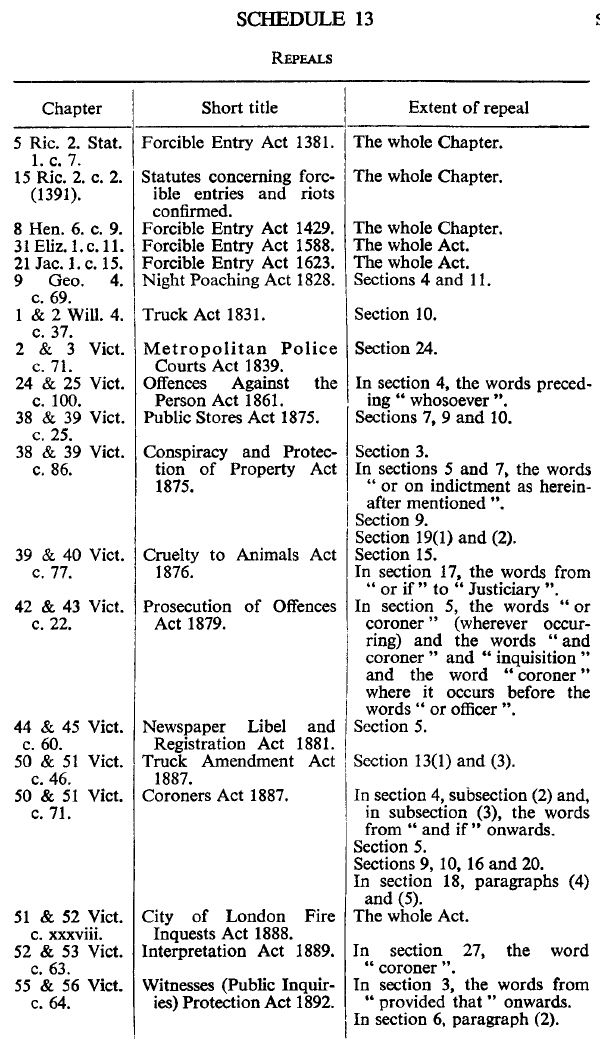
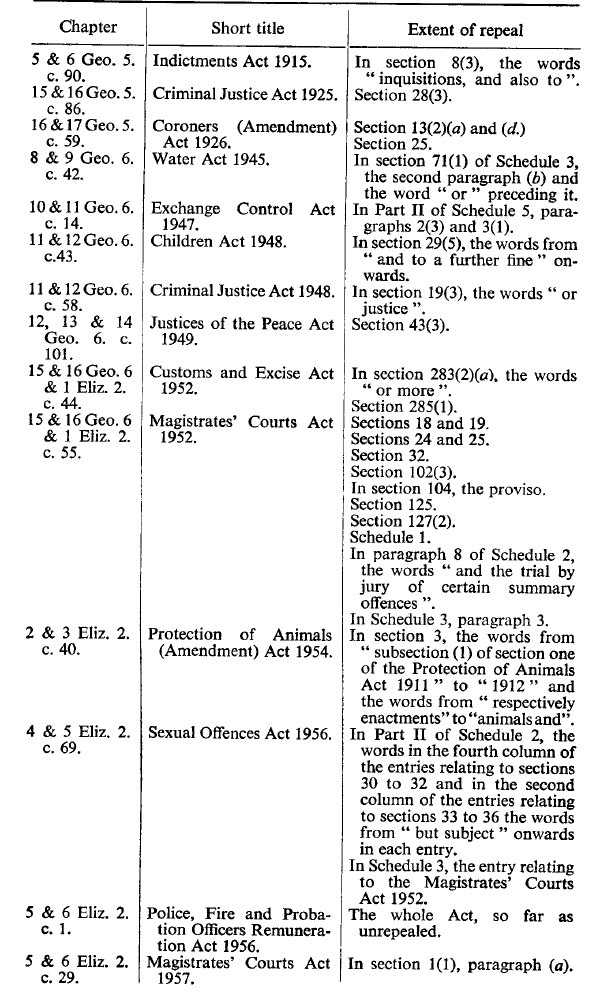
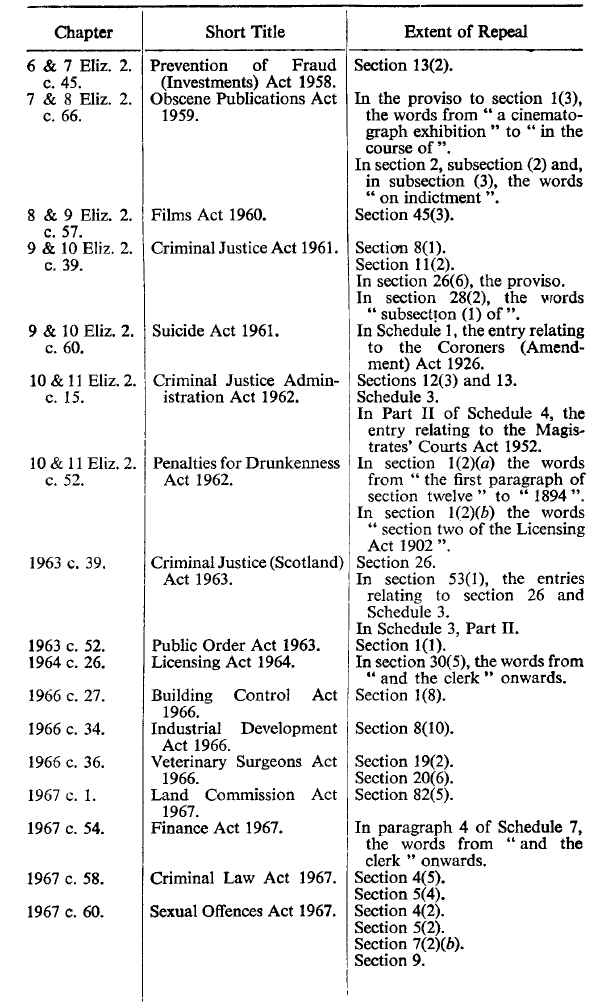
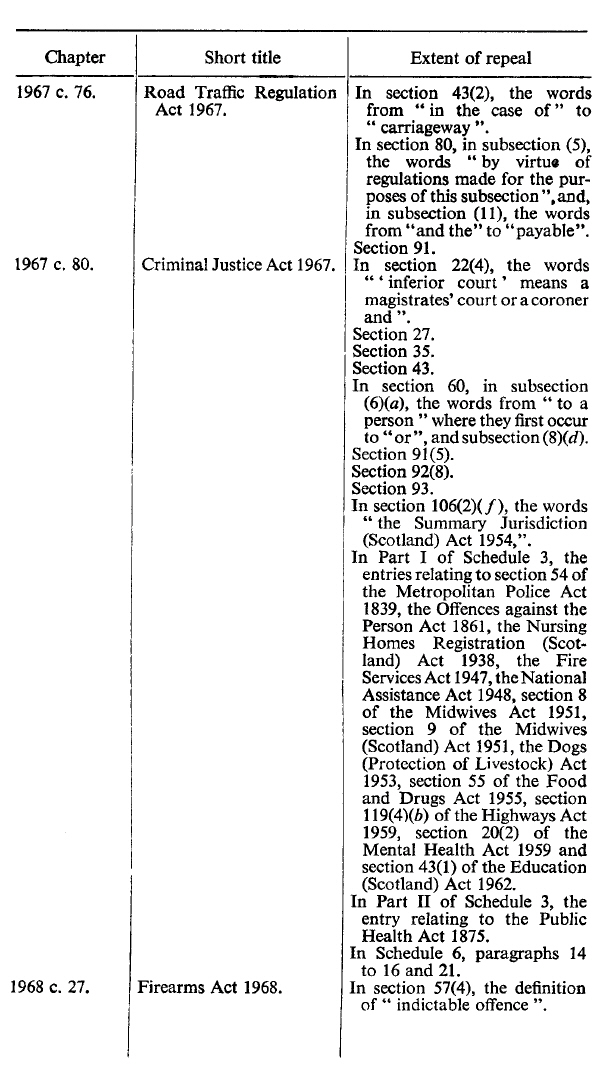
X105 Subject to the transitional provisions contained in this Act, the enactments specified in Schedule 13 to this Act (which include certain spent provisions) are hereby repealed to the extent specified in the third column of that Schedule.
6 There shall be defrayed out of money provided by Parliament any increase attributable to the provisions of this Act in the sums payable out of such money under any other Act.
P17 This Act shall come into force on such day as the Secretary of State may appoint by order made by statutory instrument, and different days may be so appointed for different purposes.
8 Without prejudice to any other transitional provision contained in this Act, the transitional provisions contained in Schedule 14 to this Act shall have effect.
9 Without prejudice to Schedule 14 or any other transitional provision contained in this Act, an order under subsection (7) above may make such transitional provision as appears to the Secretary of State to be necessary or expedient in connection with the provisions thereby brought into force.
10 In this Act—
a Part V and, so far as there provided, the provisions mentioned in section 63(2) above extend to Scotland;
b the following provisions extend to Northern Ireland namely—
  • sections 38 to 40,
  • . . . . . . . . . . . . . . . . . . . . . . . . . . . . . . . . F86
  • section 52,
  • . . . . . . . . . . . . . . . . . . . . . . . . . . . . . . . . F87
  • subsections (1), (3) and (6) to (10) of this section,
  • Schedule 7,
  • in Schedule 14, paragraph 5;
c section 31 and Schedule 6, so far as they amend any enactment which extends to the Channel Islands or the Isle of Man, extend to the Channel Islands or the Isle of Man, as the case may be;
d subsections (4) and (5) above and Schedules 12 and 13, so far as they relate to—
i section 45 of the M29Prison Act 1952 (in its application to persons for the time being in Northern Ireland or in the Channel Islands or the Isle of Man);
ii Part III and section 39(1) of the M30Criminal Justice Act 1961; and
iii sections 60 and 63 of the M31Criminal Justice Act 1967 (in their application to persons for the time being in Northern Ireland or in the Channel Islands or the Isle of Man),
extend to Northern Ireland, the Channel Islands and the Isle of Man (as well as, by virtue of paragraph (a) above, to Scotland;
F223e . . . . . . . . . . . . . . . . . . . . . . . . . . . . . . . .
but save as aforesaid, this Act extends to England and Wales only.

SCHEDULES

X11SCHEDULE 1 

Offences Made Triable Only Summarily, and Related Amendments

Sections 15 and 30.

12345
OffenceEnactmentAmendmentOld PenaltiesNew penalties
Night Poaching Act 1828 (c. 69)
1. Offences under section 1 (taking or destroying game or rabbits by night or entering land for that purpose).Section 1For the words from “such offender” onwards substitute “he shall be liable on summary conviction to a fine not exceeding £200”.(a) for a first offence, on summary conviction, 3 months or £100 and, in default of finding sureties of £10, a further 6 months;£200.
(b) for a second offence, on summary conviction, 6 months or £100 and, in default of finding sureties of £20, a further 12 months;
(c) for a third offence, on conviction on indictment, 2 years or a fine or both.
2. . . . F88 . . . F88 . . . F88 . . . F88
Public Meeting Act 1908 (c. 66)
3. Offences under section 1(1) (endeavouring to break up a public meeting).Section 1(1).After “offence” add “and shall on summary conviction be liable to imprisonment for a term not exceeding six months or to a fine not exceeding £1,000 or to both”.(a) on summary conviction 3 months or £100 or both;6 months or £1,000 or both.
(b) on conviction on indictment 12 months or £500 or both.
Children and Young Persons Act 1933 (c. 12)
4. Offences under section 3 (allowing persons under 16 to be in brothels).Section 3.For the words from “guilty” to “twenty-five pounds” substitute “liable on summary conviction to a fine not exceeding £50”.(a) on summary conviction 6 months or £25 or both;6 months or £50 or both.
(b) on conviction on indictment 6 months or £25 or both.
Public Order Act 1936 (1 Edw. 8 & 1 Geo. 6.) (c. 6)
5.Offences under section 5 (conduct conducive to breaches of the peace).Section 5 (as substituted by section 7 of the Race Relations Act 1965).After “offence” add “and shall on summary conviction be liable to imprisonment for a term not exceeding six months or to a fine not exceeding £1,000 or to both”.(a) on summary conviction 3 months or £100 or both;6 months or £1,000 or both.
(b) on conviction on indictment 12 months or £500 or both.
Water Act 1945 (c. 42)
6. F89 . . ..F89 . . ..F89. . .F89 . . .F89 . . .
F89 . . ..
7, 8. . . . F90 . . . F90 . . . F90 . . . F90
9. . . . F91 . . . F91 . . . F91 . . . F91
F92. . .
F92. . .F92. . .F92. . .F92. . .F92. . .
11—13. . . . F93 . . . F93 . . . F93 . . . F93
14—16 . . . F94 . . . F94 . . . F94 . . . F94
Betting Gaming and Lotteries Act 1963 (c.2)
17. F204...F204F204F204F204
F204F204
F204
F204
F204
F204
F204
F204
Police Act 1964 (c. 48)
F9518.. . .F95. . .F95. . ..F95. . .F95. . .
Theatres Act 1968 (c. 54)
19. Offences under section 6 (provocation of breach of the peace by means of public performance of play).Section 6(2).For paragraphs (a) and (b) subtitute “on summary conviction to a fine not exceeding £1,000 or to imprisonment for a term not exceeding six months or to both”.(a) on summary conviction 3 months or £100 or both;6 months or £1,000 or both.
(b) on conviction on indictment 12 months or £500 or both.
20. . . . F96 . . . F96 . . . F96 . . . F96
Health and Safety at Work etc. Act 1974 (c. 37)
21. Offences under section 33(5) (continuing contravention of improvement notice, prohibition notice or court order).Section 33(5).For the words from “liable” to “£50” substitute “liable on summary conviction to a fine not exceeding £100”.£50 for each day on which the contravention continues.£100 for each day on which the contravention continues.

SCHEDULES 2—4 

. . . F97

X12SCHEDULE 5 

Alteration of Penalties on Summary Conviction of Certain Offences Triable Either Way

Section 28.

1
1 The M32Misuse of Drugs Act 1971 shall be amended as follows—
a . . . . . . . . . . . . . . . . . . . . . . . . . . . . . . . . F98
b in the entries in Schedule 4 showing the punishment that may be imposed on persons summarily convicted of offences mentioned in subparagraph (2)(b) below, for “6 months or £200, or both” there shall be substituted “three months or £500, or both”; and
c in the entry in Schedule 4 relating to section 5(2)—
i for “6 months or £400, or both” (being the maximum punishment on summary conviction of an offence under that section where a Class B drug was involved) there shall be substituted “3 months or £500, or both”; and
ii for “6 months or £200, or both” (being the maximum punishment on summary conviction of such an offence where a Class C drug was involved) there shall be substituted “3 months or £200, or both”.
1A The offences mentioned in subparagraph (1)(b) above are offences under the following provisions of the Misuse of Drugs Act 1971, where the controlled drug in relation to which the offence was committed was a Class C drug, namely—
i section 4(2) (production, or being concerned in the production of a controlled drug);
ii section 4(3) (supplying or offering a controlled drug or being concerned in the doing of either activity by another);
iii section 5(3) (having possession of a controlled drug with intent to supply it to another);
iv section 8 (being the occupier, or concerned in the management, of premises and permitting or suffering certain activities to take place there);
v section 12(6) (contravention of direction prohibiting practitioner etc. from possessing, supplying etc. controlled drugs); or
vi section 13(3) (contravention of direction prohibiting practitioner etc. from prescribing, supplying etc. controlled drugs).
2 The offences to which (as provided in section 28(8) above) section 28(2) above does not apply are—
a . . . . . . . . . . . . . . . . . . . . . . . . . . . . . . . . F100
c offences under the following provisions of the M33Customs and Excise Act 1952, where the controlled drug constituting the goods in respect of which the offence was committed was a Class C drug, namely—
i section 45(1) (improper importation);
ii section 56(2) (improper exportation);
iii section 304 (fraudulent evasion of prohibition or restriction affecting goods).
3 In this paragraph “controlled drug”, “Class B drug” and “Class C drug” have the same meaning as in the M34Misuse of Drugs Act 1971.
2. . . . . . . . . . . . . . . . . . . . . . . . . . . . . . . . F101

X13Schedule 6 

Increase of fines for certain summary offences

1234
Enactment creating offencePenalty enactmentOld maximum fineNew maximum fine
Metropolitan Police Act 1839 (c. 47)
Offences under section 54 (miscellaneous offences in thoroughfares, including furious driving, obstructing a thoroughfare and discharging firearms).Section 54 (as amended by Schedule 3 to the Criminal Justice Act 1967).£20£50.
. . . F102 . . . F102 . . . F102 . . . F102
Licensing Act 1872 (c. 94)
Offences under the first paragraph of section 12 (being found drunk in a highway or other public place).Section 12 (as amended by section 1 of the Penalties for Drunkenness Act 1962).£5.£25.
. . . F103 . . . F103 . . . F103 . . . F103
Licensing Act 1902 (c. 28)
Offences under section 2(1) (being drunk in a highway or other public place while in charge of a child).Section 2(1) (as amended by section 1 of the Penalties for Drunkenness Act 1962).£10.£50.
. . . F104 . . . F104 . . . F104 . . . F104
Protection of Animals (Scotland) Act 1912 (c. 14)
Offences under section 1(1) (inflicting of unnecessary suffering on, and cruelty to, animals).Section 1 (1) (as amended by section 3 of the Protection of Animals (Amendment) Act 1954.)£50.£500.
Children and Young Persons Act 1933 (c. 12)
Offences under section 39(2) (Publication of matters identifying juveniles in court proceedings).Section 39(2).£50.£500.
Offences under section 49 (newspaper reports of proceedings in juvenile courts).Section 49(2).£50.£500.
Protection of Animals Act 1934 (c. 21)
Offences under section 1(1) (prohibition of certain public contests, performances and exhibitions with horses or bulls).Section 2.£100.£500.
Public Health Act 1936 (c. 49)
F105. . .F105. . .F105. . .F105. . .
Offences under section 290(6) (failure to execute works).Section 290(6).£5.£500.
Public Order Act 1936 (1 Edw. 8. & 1 Geo. 6.) (c. 6)
Offences under the following provisions—Section 7(2).£50.£500.
section 1(1) (wearing uniform signifying association with political organisation);
section 3(4) (knowingly failing to comply with conditions as regards processions);
section 4(1) (possession of offensive weapon at public meeting).
Children and Young Persons (Scotland) Act 1937 (c.37)
Offences under section 46(2) (Publication of matters identifying juveniles in court proceedings).Section 46(2).£50.£500.
Cinematograph Films (Animals) Act 1937 (c.59)
Offences under section 1(1) (prohibition of films in production of which suffering has been caused to animals).Section 1(3).£100.£200.
F106. . .
Nursing Homes Registration (Scotland) Act 1938 (c. 73)
Any offence under the Act for which no express penalty is provided, except an offence under section 1(4).Section 8 (as amended by Schedule 3 to the Criminal Justice Act 1967).£20.£500.
Education Act 1944 (c. 31)
F108. . .F108. . .F108. . .F108. . .
F108. . .
F108. . .
F109 . . ..
F109 . . ..F109. . ..F109. . ..
F109 . . ..F109 . . ..F109 . . ..F109. . ..
. . . F110 . . . F110 . . . F110 . . . F110
Water (Scotland) Act 1946 (c. 42)
Offences under section 59(3) (contravention of prohibition or restriction on use of hosepipes).Section 59(3).£5.£200.
Any offence consisting in a contravention of section 30(1) of Schedule 4 (wasting water by non-repair of pipes etc.).Section 30(1) of Schedule 4.£5.£200.
Any offence consisting in a contravention of section 33 of Schedule 4 (causing the supply of water to be interfered with).Sectionn 33 of Schedule 4.£5.£200.
Fire Services Act 1947 (c. 41)
offences under section 31(1) (giving false fire alarm).Section 31(1) (as amended by Schedule 3 to the Criminal Justice Act 1967).£50.£500.
National Assistance Act 1948 (c. 29)
. . . F111 . . . F111 . . . F111 . . . F111
Offences under section 55(2) (obstruction).Section 55(2) (as amended by Schedule 3 to the Criminal Justice Act 1967).£10 for a first offence and £20 for a second or subsequent offence.£500
. . . F112 . . . F112 . . . F112 . . . F112
Agriculture (Scotland) Act 1948 (c. 45)
Offences under section 50(1) (prohibition of night shooting and use of spring traps).Section 50(2).£20 for a first offence and £50 for a second or subsequent offence.£200.
Offences under section 50A(1) (open trapping of hares and rabbits).Section 50A(2).£20 for a first offence and £50 for a second or subsequent offence.£200.
. . . F113 . . . F113 . . . F113 . . . F113
Docking and Nicking of Horses Act 1949 (c. 70)
Offences under section 1(1) (prohibition of docking or nicking horses).Section 1(3).£25.£200.
Offences under section 2(3) (offences in connection with importation of docked horses).Section 2(3).£25.£200.
Offences under section 2(4) (making a false statement).Section 2(4).£25.£200.
. . . F114 . . . F114 . . . F114 . . . F114
. . . F115 . . . F115 . . . F115 . . . F115
. . . F116 . . . F116 . . . F116 . . . F116
Cockfighting Act 1952 (c. 59)
Offences under section 1(1) (possession of appliances for use in fighting of domestic fowl).Section 1(1).£25.£200.
Dogs (Protection of Livestock) Act 1953 (c. 28)
Offences under section 1(1) (owning or keeping a dog which worries livestock).Section 1(6) (as amended by Schedule 3 to the Criminal Justice Act 1967).£20 for a first offence and £50 for a second or subsequent offence in respect of the same dog.£200.
. . . F117 . . . F117 . . . F117 . . . F117
Pests Act 1954 (c. 68)
Offences under section 8(1) (restrictions on unlawful spring traps).Section 8(2).£20 for a first offence and £50 for a second or subsequent offence.£200.
Offences under section 9(1) (open trapping of hares and rabbits).Section 9(2).£20, or, if the offender has been previously convicted as mentioned in section 9(2), £50.£200.
Offences under section 12 (spreading of myxomatosis).Section 12.£20 for a first offence and £50 for a second or subsequent offence.£200.
. . . F118 . . . F118 . . . F118 . . . F118
. . . F119 . . . F119 . . . F119 . . . F119
. . . F120 . . . F120 . . . F120 . . . F120
Street Offences Act 1959 (c. 57)
Offences under section 1 (loitering or soliciting for purposes of prostitution).Section 1(2).£10 for a first offence and £50 for a second or subsequent offence.£50 for a first offence and £200 for a second or subsequent offence.
Mental Health Act 1959 (c. 72)
Offences under section 20(2) (breach of a condition of the registration of a residential home).Section 20(2) (as amended by Schedule 3 to the Criminal Justice Act 1967).£20.£500.
. . . F121 . . . F121 . . . F121 . . . F121
Animals (Cruel Poisons) Act 1962 (c. 26)
Offences under section 1 (offences in connection with use of prohibited poison for destroying animals).Section 1£50.£200.
Education (Scotland) Act 1962 (c. 47)
Offences under the following provisions—Section 43(1) (as amended by Schedule 3 to the Criminal Justice Act 1967).£10 for a first offence and £20 for a second or subsequent offence.£50.
section 35(1) (failure by parent to secure regular attendance by his child at a public school);
section 41 (failure to comply with requirements of school attendance order);
section 42(3) (refusal to allow medical officer of appropriate Health Board to examine child).
Deer Act 1963 (c. 36)
Any offence under the Act.Section 8.£20 for a first offence and £50 for a second or subsequent offence.£500.
Licensing Act 1964 (c. 26)
. . . F122 . . . F122 . . . F122 . . . F122
Offences under section 174(2) (refusal of person who is drunk etc. to leave licensed premises on request).Section 174(2).£5.£25.
F123. . .
. . . F124 . . . F124 . . . F124 . . . F124
Housing (Scotland) Act 1966 (c. 49)
Offences under section 110(1)(a) and (b) (failure to comply with notice requiring execution of works) where committed in respect of a notice served under section 107 (provision of means of escape from fire).Section 110(1)(a) and (b).£100.£500.
Road Traffic Regulation Act 1967 (c. 76)
Offences under section 13(4) (Contravention of provisions as to use of special roads).Section 13(4) (as amended by Part II of Schedule 5 to the Road Traffic Act 1974).£100.£500.
Police (Scotland) Act 1967 (c. 77)
Offences under section 41(1) (assaults on constables etc), where the offender has not, within the period of two years immediately preceding the offence, been convicted of an offence against the section.Section 41(1).£50.£500.
Sea Fisheries (Shellfish) Act 1967 (c. 83)
Offences under section 7(4) (using prohibited fishing implements etc. in an area of fishery or oyster bed to which section applies).Section 7(4).£2 for a first offence, £5 for a second offence and £10 for a third or subsequent offence.£200.
Abortion Act 1967 (c. 87)
Offences under section 2(3) (contravening or failing to comply with regulations as to notification).Section 2(3).£100.£1000.
Agriculture (Miscellaneous Provisions) Act 1968 (c. 34)
Offences under the following provisions—Section 7(1).£100 for a first offence and £200 for a second or subsequent offence.£500.
section 1(1) (prevention of unnecessary pain and distress to livestock);
section 2(2) (breach of regulations with respect to welfare of livestock).
Social Work (Scotland) Act 1968 (c. 49)
Offences under section 6(5) (obstructing officer in exercise of power under section 6).Section 6(5).£10 for a first offence and £50 for a second or subsequent offence.£500.
Offences under section 60(3) (failure to comply with regulation etc. in respect of the control of residential and other establishments).Section 60(3).£50.£500.
Offences under section 61(3) (carrying on establishment without registration).Section 61(3).£50 for a first offence and £100 for a second or subsequent offence.£500.
Offences under section 62(6) (failure to comply with a condition of the registration of an establishment).Section 62(6).£50 for a first offence and £100 for a second or subsequent offence.£500.
Offences under section 65(4) (obstructing officer in exercise of power under section 65).Section 65(4).£10 for a first offence and £50 for a second or subsequent offence.£500.
F202. . .
F202. . .F202. . .F202. . .£500.
. . . F125 . . . F125 . . . F125 . . . F125
Late Night Refreshment Houses Act 1969 (c.53)
Offences under section 9(4) (refusal of person who is drunk, etc. to leave licensed late night refreshment house on request).Section 11(3).£5.£25.
Employers’ Liability (Compulsory Insurance) Act 1969 (c.57)
Offences under section 4(3) (offences in relation to certificates of insurance).Section 4(3).£50.£200.
Offences under section 5 (employer failing to insure employee).Section 5.£200.£500.
Conservation of Seals Act 1970 (c. 30)
Any offence under the Act, except an offence under section 11(7).Section 5(2).£50 for a first offence and £100 for a second or subsequent offence.£500.
Misuse of Drugs Act 1971 (c. 38)
Offences under section 17(3) (failure to comply with notice requiring information relating to prescribing supplying etc. of drugs)Schedule 4.£100.£200.
Road Traffic Act 1972 (c. 20)
Offences under section 3 (careless, and inconsiderate, driving).Part I of Schedule 4 (as amended by Part III of Schedule 5 to the Road Traffic Act 1974).£200.£500.
Poisons Act 1972 (c. 66)
Any offence under section 8(1) (contravention of provisions of sections 1 to 7, other than section 6(4), or of the Poisons Rules).Section 8(1).£50.£500.
Offences under section 6(4) (using title etc. falsely to suggest entitlement to sell poison).Section 6(4)£20.£50.
Offences under section 9(8) (obstructing an inspector etc.).Section 9(8).£5.£50.
Health and Safety at Work etc. Act 1974 (c.37)
Offences under the following provisions—Section 33(2).£400.£1,000.
section 33(1)(d) (contravening requirement imposed by or under section 14 or obstructing any person in exercise of his powers under section 14);
section 33(1)(e) (contravening requirement imposed by inspector) where the requirement contravened was imposed under section 20;
section 33(1)(f) (preventing etc. any other person from appearing before inspector);
section 33(1)(h) (intentionally obstructing an inspector);
section 33(1)(n) (falsely pretending to be an inspector).
Control Of Pollution Act 1974 (c. 40)
Offences under section 78(1) (burning insulation from a cable).Section 78(2) (as substituted by the Clean Air Enactments (Repeals and Modifications) Regulations 1974).£400.£1,000.
F126. . .
F127. . .
F127. . .F127. . .F127. . .F127. . .
. . . F128 . . . F128 . . . F128 . . . F128
Salmon and Freshwater Fisheries Act 1975 (c. 51)
Offences against any provision of the Act not specified in the Table in Part I of Schedule 4.Paragraph 1(2) of Schedule 4.£50 for a first offence and £100 for a second or subsequent offence.£500.
Offences under section 1 (fishing with certain instruments for salmon, trout or freshwater fish and possessing certain instruments for fishing for such fish) if not acting with another.The Table in Part I of Schedule 4.£50 for a first offence and £100 for a second or subsequent offence.£500.
Offences under section 19(2) (fishing for salmon during the annual close season or weekly close time).The said Table.£100 for a first offence and £200 for a second or subsequent offence.£500.
Offences under section 19(4) (fishing for trout during the annual close season or weekly close time).The said Table.£100 for a first offence and £200 for a second or subsequent offence.£500.
Offences under section 19(6) (fishing for freshwater fish during the annual close season for freshwater fish and fishing for eels by means of a rod and line during that season).The said Table.£100 for a first offence and £200 for a second or subsequent offence.£500.
Offences under section 19(7) (fishing for rainbow trout during the annual close season for rainbow trout and fishing for eels by means of a rod and line during that season).The said Table.£100 for a first offence and £200 for a second or subsequent offence.£500.
Offences under section 21 (prohibition on use of certain devices at certain times).The said Table.£100 for a first offence and £200 for a second or subsequent offence.£500.
Offences under section 27 (fishing for fish otherwise than under the authority of a licence and possessing an unlicensed instrument with intent to use it for fishing) if not acting with another.The said Table.£50 for a first offence and £100 for a second or subsequent offence.£500.
Prevention of Terrorism (Temporary Provisions) Act 1976 (c. 8)
Offences under section 2(1) (display of support in public for a proscribed organisation).Section 2(1).£400.£1,000.
Offences under paragraph 1(9) of Schedule 3 (contravention of order under section 13).Paragraph 1(9) of Schedule 3.£200.£500.

X14SCHEDULE 7 

Transfer of Fine Orders

Section 40.

1. . . . . . . . . . . . . . . . . . . . . . . . . . . . . . . . F129

Scotland

F1302. . . . . . . . . . . . . . . . . . . . . . . . . . . . . . . .
3. . . . . . . . . . . . . . . . . . . . . . . . . . . . . . . . F131

SCHEDULE 8 

. . . F132

X15SCHEDULE 9 

Matters Ancillary to Section 47

Section 47.

Probation orders

1Where a court makes an order under section 47(1) above with respect to a sentence of imprisonment, it shall not make a probation order in the offender’s case in respect of another offence of which he is convicted by or before that court, or for which he is dealt with by that court.

Courts competent to restore sentence held in suspense

2
1 In relation to a sentence of imprisonment part of which is held in suspense, the courts competent under section 47(3) above are—
a the Crown Court; and
b where the sentence was passed by a magistrates’ court, any magistrates’ court before which the offender appears or is brought.
2 Where an offender is convicted by a magistrates’ court of an offence punishable with imprisonment and the court is satisfied that the offence was committed during the whole period of a sentence passed by the Crown Court with an order under section 47(1) above—
a it may, if it thinks fit, commit him in custody or on bail to the Crown Court; and
b if it does not, it shall give written notice of the conviction to the appropriate officer of that court.
3 For the purposes of this and the next following paragraph, a sentence of imprisonment passed on an offender with an order under section 47(1) above shall be treated as having been passed (with such an order) by the court which originally sentenced him.

Recall of offender on re-conviction

3
1 If it appears to the Crown Court, where that court has jurisdiction in accordance with sub-paragraph (2) below, or to a justice of the peace having jurisdiction in accordance with that sub-paragraph that an offender has been convicted in Great Britain of an offence punishable with imprisonment committed during the whole period of a sentence passed with an order under section 47(1) above and that he has not been dealt with in respect of the part of the sentence held in suspense, that court or justice may, subject to the following provisions of this paragraph, issue a summons requiring the offender to appear at the place and time specified therein, or a warrant for his arrest.
2 Jurisdiction for the purposes of sub-paragraph (1) above may be exercised—
a if the sentence was passed by the Crown Court, by that court;
b if it was passed by a magistrates’ court, by a justice acting for the area for which that court acted.
3 Where an offender is convicted by a court in Scotland of an offence punishable with imprisonment and the court is informed that the offence was committed during the whole period of a sentence passed in England and Wales with an order under section 47(1) above, the court shall give written notice of the conviction to the appropriate officer of the court by which the original sentence was passed.
4 Unless he is acting in consequence of a notice under sub-paragraph (3) above, a justice of the peace shall not issue a summons under this paragraph except on information and shall not issue a warrant under this paragraph except on information in writing and on oath.
5 A summons or warrant issued under this paragraph shall direct the offender to appear or to be brought before the court by which the original sentence of imprisonment was passed. F133

Consecutive sentences of imprisonment

3A
1 This paragraph applies where—
a an offender is serving consecutive sentences of imprisonment; and
b at least one of the sentences was passed with an order under section 47(1) of this Act.
2 Where this paragraph applies the offender shall, so far as the consecutive sentences are concerned, be treated for the purposes—
a of computing the date when he should be released from prison; and
b of calculating the term of imprisonment liable to be restored under section 47(3) of this Act,
as if he had been sentenced to a single term of imprisonment with an order under section 47(1) of this Act of which the part which he is immediately required to serve in prison were the aggregate—
i of the part which he is required to serve in prison of any consecutive sentence passed with an order under section 47(1) of this Act; and
ii of the whole term of any other consecutive sentence,
and of which the part which is held in suspense were the aggregate of all parts of the sentences which were ordered to be held in suspense under that section.
3 Section 47(6) of this Act shall have effect, in relation to any consecutive sentence passed with an order under section 47(1) of this Act, as if for the words following the word “prison” there were substituted the following words
.
4 In this paragraph “a consecutive sentence” means a sentence which is one of two or more sentences of imprisonment the terms of which have been ordered to run consecutively.

Miscellaneous (procedural)

4Where the offender is before the Crown Court with a view to the exercise by that court of its powers under section 47(3) above, any question whether and, if so, when he has been convicted of an offence shall be determined by the court and not by the verdict of a jury.
5Where the offender has been before a court with a view to its exercising those powers, the appropriate officer shall—
a if the court decided not to exercise the powers, record that fact; and
b whether or not it exercised them, notify the appropriate officer of the court which passed the original sentence as to the manner in which the offender was dealt with.
6For the purposes of any enactment conferring rights of appeal in criminal cases, the restoration by a court under section 47(3) above of a part of a sentence held in suspense shall be treated as a sentence passed on the offender by that court for the original offence, that is to say the offence for which the original sentence was passed with an order under section 47(1) above.

Miscellaneous (consequential)

7Subject to section 60(1C) of the Criminal Justice Act 1967 (release on licence), where a sentence of imprisonment is passed with an order under section 47(1) above, it is still to be regarded for all purposes as a sentence of imprisonment for the term stated by the court, notwithstanding that part of it is held in suspense by virtue of the order; and, for the avoidance of doubt, a sentence of which part is held in suspense by virtue of such an order is not to be regarded as falling within the expression “suspended sentence” for the purposes of any legislation, instrument or document.
8Where an offender is sentenced to imprisonment with an order under section 47 above and, having served part of the sentence in prison, is discharged under section 25(1) of the M35Prison Act 1952 (remission for industry and good conduct), the remainder of the sentence being held in suspense, the sentence is not to be regarded as expiring under that section.
9In section 21 of the M36Firearms Act 1968 (prohibition on possession of firearms by persons previously convicted of crime), after subsection (2) there shall be inserted—
.
10In section 67 of the M37Criminal Justice Act 1967 (computation of sentence where offender has been previously in custody), in subsection (1), after “arose, but” there shall be inserted “(a)”, . . . F135.
11In section 1 of the M38Rehabilitation of Offenders Act 1974 (general principle as to rehabilitation when conviction is spent), after subsection (2) there shall be inserted—
.

SCHEDULE 10 

. . . F136

X16F148SCHEDULE 11 

Amendments of Criminal Procedure (Scotland Act) 1975]

F1371There shall be inserted after section 193 a new section as follows—
.
F1382There shall be inserted after section 283 a new section as follows—
.
3. . . . . . . . . . . . . . . . . . . . . . . . . . . . . . . . F139
F1404
1 In section 289(a), for “£150” there shall be substituted “the prescribed sum (within the meaning of section 289B below)”.
2 In section 289(b) for “£150” there shall be substituted “the prescribed sum (within the meaning of section 289B below)]”.
F1415There shall be inserted after section 289 new sections as follows—
.
6. . . . . . . . . . . . . . . . . . . . . . . . . . . . . . . . F142
F1437For section 394(b) there shall be substituted the following paragraph—
.
F1448In section 397(1) for the words “or under section 72A of the M39Magistrates’ Courts Act 1952” there shall be substituted the words “, under section 72A of the Magistrates’ Courts Act 1952 or under section 104A of the M40Magistrates’ Courts Act (Northern Ireland) 1964]”.
F1459In section 414(1) after the word “convicted” there shall be inserted the words “summarily by a sheriff or stipendiary magistrate]”.
F14610In section 462, in the interpretation of “fine” there shall be inserted after the word “includes” the words “(a) any pecuniary penalty, and (b)]”.
11. . . . . . . . . . . . . . . . . . . . . . . . . . . . . . . . F147

X17SCHEDULE 12 

Minor and Consequential Amendments

Section 65.

NIGHT POACHING ACT 1828 (C. 69) 

1In section 2 (assaults by persons committing offences under the Act), for the words from “whether it be” onwards substitute “be liable on summary conviction to imprisonment for a term not exceeding six months or a fine not exceeding £500, or both”.
2In section 9 (entering land, with others, armed and for the purpose of taking or distroying game or rabbits), for the words from “at the discretion of the court” onwards substitute “on summary conviction to imprisonment for a term not exceeding six months or to a fine not exceeding £500, or to both”.

METROPOLITAN POLICE COURTS ACT 1839 (C. 71) 

Section 24 (offence of possessing stolen goods without a satisfactory explanation) shall cease to have effect.

ACCESSORIES AND ABETTORS ACT 1861 (C. 94) 

In section 8 (abettors in misdmeanors,) for “any misdemeanor” substitute “any indictable offence”, and for “a misdemeanor” substitute “an offence”.

OFFENCES AGAINST THE PERSON ACT 1861 (C. 100) 

For section 16 (sending letters threatening to murder) substitute—

PUBLIC STORES ACT 1875 (C. 25) 

Section 7 (offences of possessing, without a satisfactory explanation public stores suspected of being stolen) and section 9 (offence, applicable to certain dealers and others, of possessing, without a satisfactory explanation, property reasonabley believed to be public stores) shall cease to have effect.

EXPLOSIVE SUBSTANCES ACT 1883 (C. 3) 

In section 3(1) (attempt to cause explosion, or making or keeping explosive, with intent to endanger life or property in the United Kingdom or the Republic of Ireland), for “a term not exceeding twenty years” substitute “life”.

CORONERS ACT 1877 (c. 71) 

Section 4(2) (duty of coroner to take depositions in a case of murder or manslaughter) shall cease to have effect.

CHILDREN ACT 1948 (c.43) 

In section 29(5)(carrying on an unregistered voluntary home) omit the words from “and to a further fine” onwards (which provide for a fine of £2 in respect of each day during which an offence under the subsection continues after conviction).

. . . . . . . . . . . . . . . . . . . . . . . . . . . . . . . . F149 

. . . . . . . . . . . . . . . . . . . . . . . . . . . . . . . . F150 

. . . . . . . . . . . . . . . . . . . . . . . . . . . . . . . . F151 

. . . . . . . . . . . . . . . . . . . . . . . . . . . . . . . . F152 

BIRTHS AND DEATHS REGISTRATION ACT 1953 (c. 20) 

In section 29(4) (correction of error in register resulting from error in information given by a coroner’s certificate), for the words preceding “the coroner, if satisfied”, substitute—

.

SEXUAL OFFENCES ACT 1956 (C.69) 

1A prosecution for an offence to which paragraph 14 or 15 (incest and attempts thereat) of Part II of Schedule 2 (table of offences with mode of prosecution) relates shall not be commenced except by or with the consent of the Director of Public Prosecutions; and accordingly in sub-paragraph (a) and (b) of each of those paragraphs, in the second column, for the words from “without” to “behalf” substitute “except by or with the consent”.
2In paragraphs 17 and 18 of the said Part II (indecent assault)—
a for sub-paragraph (ii)in the second column substitute—
;
b in the third column, for the words “As provided” to “or both)” substitute—
.

ADOPTION ACT 1958 (7&8 Eliz.2.c.5.) 

In section 50 (prohibition of certain payments), after subsection (3) insert—

OBSCENE PUBLICATIONS ACT 1959 (c. 66) 

In section 3(3) (powers of search and seizure) at end add—

.

CRIMINAL JUSTICE ACT 1961 (c. 39) 

1. . . . . . . . . . . . . . . . . . . . . . . . . . . . . . . . F153
2
1 Section 26 (transfer of prisoner to serve sentence) shall be amended as follows.
2 In subsection (1) (power of responsible Minister to order transfer of prisoner from one part of the United Kingdom to another)—
a after “to another part of the United Kingdom” insert “or to any of the Channel Islands or the Isle of Man”; and
b for “in that part of the United Kingdom” substitute “there”.
3 . . . . . . . . . . . . . . . . . . . . . . . . . . . . . . . . F154
3
1 Section 28 (transfer of prisoner for trial) shall be amended as follows.
2 In subsection (1) (power of responsible Minister to order transfer from one part of the United Kingdom to another)—
a after “to another part of the United Kingdom” insert “or to any of the Channel Islands or the Isle of Man”; and
b after “that other part” insert “or that island”.
3 After subsection (1) insert—
.
4 In subsection (2) (treatment of transferred prisoner while he remains in the part of the United Kingdom to which he has been transferred under subsection (1)), omit “subsection (1) of” and after “United Kingdom” insert “or island”.
5 In subsection (3) (transfer back after trial)—
a after “subsection (1)”, wherever occurring, insert “or (1A)”;
b after “Minister” insert “(in the case of a person so transferred to any part of the United Kingdom) or the Secretary of State (in the case of a person so transferred to any of the Channel Islands or the Isle of Man)”; and
c after “country”, wherever occurring, insert “or island”.
4
1 Section 29 (removal of detained person in the interests of justice or for the purposes of a public inquiry) shall be amended as follows.
2 In subsection (1) (power of responsible Minister to direct removal from one place to another within the United Kingdom), after “other part of the United Kingdom” insert “or in any of the Channel Islands or the Isle of Man”.
3 After subsection (1) insert—
.
4 In subsection (2), for “responsible Minister” substitute “Minister by whom that direction is given”.
5In section 39(1) (interpretation) in paragraph (b) of the definition of “responsible Minister” for “the Minister of Home Affairs for Northern Ireland” substitute “the Secretary of State”.

LICENSING ACT 1964 (c. 26) 

1. . . . . . . . . . . . . . . . . . . . . . . . . . . . . . . . F155
2. . . . . . . . . . . . . . . . . . . . . . . . . . . . . . . . F156

HOUSING ACT 1964 (c. 56) 

In section 65, after subsection (1) (penalty for failure to comply with notice requiring execution of works under Part II of M41Housing Act 1961 insert—

.

HOUSING (SCOTLAND) ACT 1966 (c. 49) 

In section 110, after subsection (1) (penalty for failure to comply with notice requiring execution of works) insert—

.

CRIMINAL LAW ACT 1967 (c. 58) 

In section 2(1) (under which an offence carrying a sentence of five years imprisonment or more is an arrestable offence) after “five years” insert “(or might be so sentenced but for the restrictions imposed by section 29 of the Criminal Law Act 1977)” and at the end add—

.

. . . . . . . . . . . . . . . . . . . . . . . . . . . . . . . . F157 

CRIMINAL JUSTICE ACT 1967 (C. 80) 

1. . . . . . . . . . . . . . . . . . . . . . . . . . . . . . . . F158
2In section 22, as amended by paragraph 37 of Schedule 2 to the M42Bail Act 1976, (extension of power of High Court to grant, or vary conditions of, bail)—
a in subsection (1) and (2) for “inferior court” substitute “magistrates’ court”; and
b in subsection (4) omit “ “inferior court” means a magistrates’, court or a coroner and”.
3In section 23(2) (requirements as to bringing before a justice of the peace or court a person arrested after admission to bail), after paragraph (b) insert—
4. . . . . . . . . . . . . . . . . . . . . . . . . . . . . . . . F159
5. . . . . . . . . . . . . . . . . . . . . . . . . . . . . . . . F160
6. . . . . . . . . . . . . . . . . . . . . . . . . . . . . . . . F161
7
1 Section 60 (release on license of persons serving determinate sentences) shall be amended as follows—
2 . . . . . . . . . . . . . . . . . . . . . . . . . . . . . . . . F162
3 After subsection (5) insert—
.
4 In subsection (6) (duration of a licence, after “this section” insert “in Scotland” and, in paragraph (a), omit the words from “to a person” where they first occur to “or”.
5 Omit subsection (8)(d).
6 The preceding provisions of this paragraph shall not apply in relation to a licence granted before the coming into force of this paragraph.
8. . . . . . . . . . . . . . . . . . . . . . . . . . . . . . . . F163
9in subsection 91 (drunkeness in a public place) omit subsection (5).

COMPANIES ACT 1967 (c. 81) 

1In subsection 49(1) (certain offences to be triable summarily), after “triable” insert “only”.
2Paragraph 1 above shall be deemed to have had an effect as from the passing of the M43Companies Act 1967.

FIREARMS ACT 1968(c. 27) 

For paragraph 3 of Part II of Schedule 6 (under which a person charged with an offence specified in Schedule 1 to the Magistrates’ Courts Act 1952 and an offence under section 17(1) or (2) of the Firearms Act 1968 (using firearm to resist arrest, and possessing firearm while committing certain offences) may not be tried summarily for the former if he is sent for trial for the latter) substitute the following paragraph—

.

F164. . . . . . . . . . . . . . . . . . . . . . . . . . . . . . . .

F203... 

F203...

CHILDREN AND YOUNG PERSONS ACT 1969 (c.54)

F1651. . . . . . . . . . . . . . . . . . . . . . . . . . . . . . . .
2In section 13(3) (selection of supervisor for person placed under supervision of probation officer), omit the words from “or if,” to “place” (which provide for the selected officer to be changed at the instance of the case committee).
F1663. . . . . . . . . . . . . . . . . . . . . . . . . . . . . . . .
4In section 16(10) (meaning of “ attendance centre order” etc. for purposes of section 15(4)(a))—
a after “In”, where it first occurs, insert “ paragraph (b) of subsection (2A) and ”;
F167b . . . . . . . . . . . . . . . . . . . . . . . . . . . . . . . .
F167c . . . . . . . . . . . . . . . . . . . . . . . . . . . . . . . .
5In paragraph 6 of Schedule 4 (restriction on power to make attendance centre order), at the end add “ other than one consisting in failure to pay, or want of sufficient distress to satisfy, a sum adjudged to be paid by a conviction ”.
6Paragraphs 1 and 3 above, and any related repeal provided for in Schedule 13 to this Act, shall not apply in relation to supervision orders made before the coming into force of those paragraphs.

. . . . . . . . . . . . . . . . . . . . . . . . . . . . . . . . F168 

FINANCE ACT 1972 (C. 41) 

Paragraph 9 of Schedule 6 (right of members of value added tax tribunals to refuse to serve on juries) shall cease to have effect as regards juries in England and Wales.

. . . . . . . . . . . . . . . . . . . . . . . . . . . . . . . . F169 

ADMINISTRATION OF JUSTICE ACT 1973 (c. 15) 

1In section 9(4) (abatement of salaries of holders of certain judicial offices, including the stipendiary magistrates mentioned in subsection (1)(e) and (f), by reference to pensions payable in respect of any public office in the United Kingdom or elsewhere), after “United Kingdom or” insert “, except as respects any holder of judicial office mentioned in subsection (1)(e) or (f) above,”.
2Paragraph 1 above shall be deemed to have had effect as from the passing of the Administration of Justice Act 1973.

POWERS OF CRIMINAL COURTS ACT 1973 (c. 62)F176F176 

1. . . . . . . . . . . . . . . . . . . . . . . . . . . . . . . .
2For section 2(5)(b) (which requires a probation order requiring residence in an institution to specify the name of the institution as well as the required period of residence, and imposes a limit of twelve months on that period) substitute—
.
3In section 9(1) (breach of conditional discharge by young offenders)—
a for the words from “not being” to “1952” substitute “triable only on indictment in the case of an adult.”;
b for the words from “such an offence” onwards substitute “an offence triable either way and had been tried summarily.”.
F1704. . . . . . . . . . . . . . . . . . . . . . . . . . . . . . . .
5In section 17(3) (power of Crown Court to revoke or vary community service orders), for the words from the beginning to “and it appears to the Crown Court” substitute—
.
F1716. . . . . . . . . . . . . . . . . . . . . . . . . . . . . . . .
F1727. . . . . . . . . . . . . . . . . . . . . . . . . . . . . . . .
F1738. . . . . . . . . . . . . . . . . . . . . . . . . . . . . . . .
F1749. . . . . . . . . . . . . . . . . . . . . . . . . . . . . . . .
10Paragraph 3(2)(b) of Schedule 1 (which precludes a supervising court from amending a probation order so as to require residence in an institution for more than twelve months in all) shall be omitted.
F17511. . . . . . . . . . . . . . . . . . . . . . . . . . . . . . . .

. . . . . . . . . . . . . . . . . . . . . . . . . . . . . . . . F177 

JURIES ACT 1974 (c. 23) 

F190...

HEALTH AND SAFETY AT WORK ETC. ACT 1974 (c. 37) 

In section 15(6)(d) (power to restrict punishments which can be imposed in respect of certain offences) after “punishments” insert “(other than the maximum fine on conviction on indictment)”.

REHABILITATION OF OFFENDERS ACT 1974 (c. 53) 

In section 6(6)(a) (convictions in England and Wales which are to be disregarded for purposes of the provisions of section 6(4)(a) as to the extension of rehabilitation periods) for “an offence which is not triable on indictment” substitute “a summary offence or of a scheduled offence (within the meaning of section 23 the Criminal Law Act 1977) tried summarily in pursuance of subsection (2) of that section (summary trial where value involved is small);”

F194F178. . . . . . . . . . . . . . . . . . . . . . . . . . . . . . . . 

BAIL ACT 1976 (c. 63) 

1In section 2(2), in the definition of “court”, for “a justice of the peace or a coroner” substitute “or a justice of the peace”.
2In section 3(8) (power of the court granting bail to vary conditions of bail or impose conditions in respect of bail granted unconditionally)—
a for “it may” substitute “that court or, where that court has committed a person on bail to the Crown Court for trial or to be sentenced or otherwise dealt with, that court or the Crown Court may”;
b for “it was” substitute “bail was”;
c for “it has” substitute “has been”.
3
1 Section 5 (supplementary provisions about bail) shall be amended as follows.
2 After subsection (8) insert—
3 After subsection (9) insert—
F1844. . . . . . . . . . . . . . . . . . . . . . . . . . . . . . . .

X18F200SCHEDULE 13 

Section 65.

SCHEDULE 14 

Transitional Provisions

Section 65.

C101A provision contained in any of sections 15 and 17 above or in Schedule 11 to this Act, and any related amendment or repeal provided for in Schedule 12 or 13 to this Act, shall not apply in relation to proceedings commenced before the coming into force of that provision.
2. . . . . . . . . . . . . . . . . . . . . . . . . . . . . . . . F180
3
1 This paragraph applies to any provision of this Act which relates to the punishment by way of fine or imprisonment which may be imposed on summary conviction of offences mentioned in section 30(3) above, in Schedule 1 . . . F181 to this Act or in Schedule 7A to the M44Criminal Procedure (Scotland) Act 1975.
2 A provision to which this paragraph applies shall have effect in relation to an offence for which proceedings are commenced after the material time even if that offence was committed before that time; but in the case of an offence committed before the material time, such a provision shall not render a person liable on summary conviction to any punishment greater than that to which he would have been liable on conviction on indictment if at the time of his conviction that provision had not yet come into force.
3 In relation to a provision to which this paragraph applies “the material time” means the time when that provision comes into force.
4. . . . . . . . . . . . . . . . . . . . . . . . . . . . . . . . F182
5Except as provided in paragraph 3 above a provision of this Act . . . F183 which relates to the punishment by way of fine or imprisonment for any offence shall not affect the punishment for an offence committed before that provision comes into force.

Footnotes

  1. X1
    The text of ss. 1–5, 14–49, 57, 58, 60–65, Schs. 1–9, 11–14 was taken from S.I.F. Group 39:1 (Criminal Law: General), ss. 51, 63(2), 65(1)(3)(7)(10) from S.I.F. Group 39:2 ( Criminal Law: Public Safety and Order), ss. 53, 54, 65(1)(3)(7)(9)(10) Group 39:5 (Criminal Law: Sexual Offences and Obscenity), ss. 6–13, 65(1)(3)(7)–(10), Sch. 14 para. 5 Group 39:6 (Criminal Law: Offences against Property); provisions omitted from S.I.F have been dealt with as referred to in other commentary.
  2. I1
    Act not in force at Royal Assent, Act wholly in force on 20.5.1985 see s. 65(7).
  3. C1
    Power to apply Act conferred by Criminal Justice Act 1988 (c. 33, SIF 39:1), s. 50(3)(b)(ii), Sch. 8 para. 16
  4. C2
    By Criminal Justice Act 1991 (c. 53, SIF 39:1), s. 101(1), Sch. 12 para. 23; S.I. 1991/2208, art. 2(1), Sch.1 it is provided (14.10.1991) that in relation to any time before the commencement of s. 70 of that 1991 Act (which came into force on 1.10.1992 by S.I. 1992/333, art. 2(2), Sch. 2) references in any enactment amended by that 1991 Act, to youth courts shall be construed as references to juvenile courts.
  5. F1
    S. 1(1) substituted (with saving) by Criminal Attempts Act 1981 (c. 47, SIF 39:1), s. 5(1)
  6. C3
    S. 1(1) modified (16.10.1992) by Trade Union and Labour Relations (Consolidation) Act 1992 (c. 52), ss. 242, 302.
  7. F2
    S. 1(1A)(1B)(5)(6) repealed (4.9.1998) by 1998 c. 40, s. 9(1)(2), Sch. 1 Pt. II para. 4(a)(c), Sch. 2 Pt.II (with s. 9(3))
  8. F3
    S. 1(3) repealed (16.10.1992) by Trade Union and Labour Relations (Consolidation) Act 1992 (c. 52), ss. 300(1), 302, Sch. 1 (with Sch. 3 para. 2).
  9. F4
    Words in s. 1(4) repealed (4.9.1998) by 1998 c. 40, s. 9(1)(2), Sch. 1 Pt. II para. 4(b), Sch. 2 Pt.II (with s. 9(3)).
  10. M1
    1987 c. 38.
  11. M2
    1996 c. 25.
  12. M3
    1933 c. 12.
  13. F5
    S. 4(5)-(7) added (4.9.1998) by 1998 c. 40, s. 5(2).
  14. F6
    Words repealed by Criminal Justice Act 1987 (c. 38, SIF 39:1), s. 12(2)
  15. X2
    The text of ss. 5(10)(11), 15(2), 17, 30(1)(2), 31(10), 32(3), 46, 49, 52, 57, 63(1), 65(4)(5), Sch. 13 is in the form in which it was originally enacted: it was not reproduced in Statutes in Force and does not reflect any amendments or repeals which may have been made prior to 1.2.1991.
  16. M4
    1861 c. 100.
  17. F7
    S. 5(11) repealed (16.10.1992) by Trade Union and Labour Relations (Consolidation) Act 1992 (c. 52), ss. 300(1), 302, Sch.1 (with Sch. 3 para. 2).
  18. C4
    Pt. I (ss. 1-5) extended (1.10.1996) by 1996 c. 29, ss.1, 3; S.I. 1996/2262, art.2.
  19. F8
    S. 1A inserted (4.9.1998) by 1998 c. 40, s. 5(1).
  20. F9
    S. 6(1A) inserted (3.2.1995) by 1994 c. 33, s. 72(2); S.I. 1995/127, art. 2(1), Sch.1.
  21. F10
    Words in s. 6(2) inserted (3.2.1995) by 1994 c. 33, s. 72(3); S.I. 1995/127, art. 2(1), Sch.1.
  22. F11
    S. 6(3) omitted (3.2.1995) by 1994 c. 33, s. 72(4) and repealed (prosp.) by 1994 c. 33, ss. 168(3), 172(2), Sch.11; S.I. 1995/127, art. 2(1), Sch.1.
  23. F12
    Words substituted by virtue of Criminal Justice Act 1982 (c. 48, SIF 39:1), s. 46
  24. F13
    Words in s. 6(7) inserted (3.2.1995) by 1994 c. 33, s. 72(5); S.I. 1995/127, art. 2(1), Sch.1.
  25. F14
    Words substituted by virtue of Criminal Justice Act 1982 (c. 48, SIF 39:1), s. 46
  26. M5
    1964 c. 81.
  27. F15
    S. 9(2)(aa) inserted by Diplomatic and Consular Premises Act 1987 (c. 46, SIF 68:1), s. 7(1)(a)
  28. M6
    1968 c. 18.
  29. F16
    S. 9(2)(bb) inserted by Diplomatic and Consular Premises Act 1987 (c. 46, SIF 68:1), s. 7(1)(b)
  30. F17
    S. 9(2A) inserted by Diplomatic and Consular Premises Act 1987 (c. 46, SIF 68:1), s. 7(2)
  31. F18
    Words substituted by virtue of Criminal Justice Act 1982 (c. 48, SIF 39:1), s. 46
  32. M7
    1887 c. 55.
  33. F19
    Words substituted by virtue of Criminal Justice Act 1982 (c. 48, SIF 39:1), s. 46
  34. C5
    S. 6(6), 7(11), 8(4), 9(7), 10(5) saved by the Police and Criminal Evidence Act 1984 (c. 60), s. 26, Sch. 2
  35. F20
    S. 11 repealed by Police and Criminal Evidence Act 1984 (c. 60, SIF 95), s. 119(2), Sch. 7 Pt. I
  36. M8
    1977 c. 42.
  37. F21
    Words in s. 12A(7)(c) repealed (1.11.1998) by 1998 c. 38, ss. 140, 152, Sch. 16 para. 3(2), Sch. 18 Pt. VI (with ss. 137(1), 139(2), 141(1), 143(2)); S.I. 1998/2244, art.5.
  38. F22
    S. 12A(7)(d) substituted (1.10.1996) by S.I. 1996/2325, art. 5(1), Sch. 2 para. 8.
  39. F23
    S. 12A(7A) inserted (1.11.1998) by 1998 c. 38, s. 140, Sch. 16 para.3(3) (with ss. 139(2), 141(1), 143(2)); S.I. 1998/2244, art. 5.
  40. M9
    1985 c. 69.
  41. M10
    1381 c. 7.
  42. M11
    1429 c. 9.
  43. M12
    1588 c. 11.
  44. M13
    1623 c. 15.
  45. F24
    S. 7 substituted (3.5.1995) by 1994 c. 33, s.73; S.I. 1995/127, art. 2(1), Sch.1.
  46. F25
    S. 12A inserted (3.2.1995) by 1994 c. 33, s. 74; S.I. 1995/127, art. 2(1), Sch. 1.
  47. F26
    S. 14 repealed by Magistrates' Courts Act 1980 (c. 43, SIF 82), Sch. 9
  48. F27
    Word “and” and s. 15(1)(b) repealed by Magistrates' Courts Act 1980 (c. 43, SIF 82), Sch. 9
  49. F28
    S. 15(2)(3) repealed (5.11.1993) by 1993 c. 50, s. 1(1), Sch. 1 Pt. I Group1
  50. M14
    1828 c. 69.
  51. F29
    Ss. 16, 18–27, 28(1)–(7), 29, 30(4) repealed by Magistrates' Courts Act 1980 (c. 43, SIF 82), Sch. 9
  52. F30
    S. 17 repealed (5.11.1993) by 1993 c. 50, s. 1(1), Sch. 1 Pt. I Group1
  53. F31
    Ss. 16, 18–27, 28(1)–(7), 29, 30(4) repealed by Magistrates' Courts Act 1980 (c. 43, SIF 82), Sch. 9
  54. F32
    Ss. 16, 18–27, 28(1)–(7), 29, 30(4) repealed by Magistrates' Courts Act 1980 (c. 43, SIF 82), Sch. 9
  55. F33
    Ss. 16, 18–27, 28(1)–(7), 29, 30(4) repealed by Magistrates' Courts Act 1980 (c. 43, SIF 82), Sch. 9
  56. F34
    Words substituted by Magistrates' Courts Act 1980 (c. 43, SIF 82), Sch. 7 para. 149
  57. F35
    Words repealed by Magistrates' Courts Act 1980 (c. 43, SIF 82), Sch. 9
  58. F36
    Ss. 16, 18–27, 28(1)–(7), 29, 30(4) repealed by Magistrates' Courts Act 1980 (c. 43, SIF 82), Sch. 9
  59. X3
    The text of ss. 5(10)(11), 15(2), 17, 30(1)(2), 31(10), 32(3), 46, 49, 52, 57, 63(1), 65(4)(5), Sch. 13 is in the form in which it was originally enacted: it was not reproduced in Statutes in Force and does not reflect any amendments or repeals which may have been made prior to 1.2.1991.
  60. M15
    1828 c. 69.
  61. F37
    Ss. 16, 18–27, 28(1)–(7), 29, 30(4) repealed by Magistrates' Courts Act 1980 (c. 43, SIF 82), Sch. 9
  62. M16
    1875 c. 55.
  63. M17
    1972 c. 70.
  64. F38
    S. 31(2)(b) repealed by Weights and Measures Act 1985 (c. 72, SIF 131), s. 98(1), Sch. 11 para. 21(2), Sch. 13
  65. M18
    1933 c. 51.
  66. M19
    1961 c. 64.
  67. F39
    Word “and” and s. 31(4)(c) repealed by Criminal Justice Act 1982 (c. 48, SIF 39:1), Sch. 16
  68. F40
    Words substituted by virtue of Criminal Justice Act 1982 (c. 48, SIF 39:1), s. 46
  69. F41
    S. 31(7) repealed by Criminal Justice Act 1982 (c. 48, SIF 39:1), Sch. 16
  70. X4
    The text of ss. 5(10)(11), 15(2), 17, 30(1)(2), 31(10), 32(3), 46, 49, 52, 57, 63(1), 65(4)(5), Sch. 13 is in the form in which it was originally enacted: it was not reproduced in Statutes in Force and does not reflect any amendments or repeals which may have been made prior to 1.2.1991.
  71. M20
    1968 c.67.
  72. C6
    S. 32(1) extended (N.I.) by Finance Act 1983 (c. 28, SIF 39:1), Sch. 9 para. 1(1)
  73. C7
    S. 32(1) excluded by Criminal Attempts Act 1981 (c. 47, SIF 82), s. 4(5)(b)(i)
  74. F42
    Ss. 32(2), 34, 35, 36(2)–(8) repealed by Magistrates' Courts Act 1980 (c. 43, SIF 82), Sch. 9
  75. M21
    1883 c. 3.
  76. F43
    Ss. 32(2), 34, 35, 36(2)–(8) repealed by Magistrates' Courts Act 1980 (c. 43, SIF 82), Sch. 9
  77. F44
    S. 36(1) repealed by Criminal Justice Act 1982 (c. 48, SIF 39:1), Sch. 16
  78. F45
    Ss. 32(2), 34, 35, 36(2)–(8) repealed by Magistrates' Courts Act 1980 (c. 43, SIF 82), Sch. 9
  79. F46
    Definition repealed by Magistrates' Courts Act 1980 (c. 43, SIF 82), Sch. 9
  80. F47
    Definition repealed by Magistrates' Courts Act 1980 (c. 43, SIF 82), Sch. 9, Criminal Justice Act 1982 (c. 48, SIF 39:1), Sch. 16
  81. M22
    1973 c. 62.
  82. M23
    1969 c. 54.
  83. X5
    The text of ss. 15(3), 37, 44, 53, 58, Schs. 1, 5, 6, 7, 9, 11, 12 is in the form in which it was originally enacted: it was not reproduced in Statutes in Force and, except as specified, does not reflect any amendments or repeals which may have been made prior to 1.2.1991.
  84. F48
    S. 37(1) repealed by Criminal Justice Act 1982 (c. 48, SIF 39:1), Sch. 16
  85. M24
    1969 c. 54.
  86. F49
    S. 38 repealed (3.2.1995) by 1994 c. 33, s. 168(3), Sch.11; S.I. 1995/127, art. 2(1), Sch. 1 AppendixC.
  87. F50
    S. 38A(5)(ia) inserted by Criminal Justice Act 1982 (c. 48, SIF 39:1), Sch. 14 para. 39
  88. F51
    Words in s. 38A(5)(ia) substituted (25.8.2000) by 2000 c. 6, ss. 165, 168(1), Sch. 9 para. 56
  89. F52
    Words in s. 38A(6) substituted (3.5.1995) by 1994 c. 33, s. 168(1), Sch. 9 para. 14(1); S.I. 1995/127, art. 2(1), Sch. 1 Appendix A.
  90. F53
    Words in s. 38B(5)(a) substituted (25.8.2000) by 2000 c. 6, ss. 165, 168(1), Sch. 9 para. 57
  91. F54
    Words in s. 38B(6) substituted (3.2.1995) by 1994 c. 33, s. 168(1), Sch. 9 para. 14(2); S.I. 1995/127, art. 2(1), Sch. 1 Appendix A.
  92. F55
    “(a)” inserted by Criminal Justice (Scotland) Act 1980 (c. 62), Sch. 7 para. 79(a)
  93. F56
    S. 39(3)(b) added by Criminal Justice (Scotland) Act 1980 (c. 62, SIF 39:1), Sch. 7 para. 79(b)
  94. F57
    S. 38A inserted by Criminal Justice (Scotland) Act 1980 (c. 62), s. 51
  95. F58
    S. 38A inserted by Criminal Justice (Scotland) Act 1980 (c. 62), s. 51
  96. F59
    S. 38B inserted by Criminal Justice Act 1982 (c. 48, SIF 39:1), s. 52
  97. F60
    S. 38B inserted by Criminal Justice Act 1982 (c. 48, SIF 39:1), s. 52
  98. F61
    Ss. 41, 42, 45 repealed by Magistrates' Courts Act 1980 (c. 43, SIF 82), Sch. 9
  99. F62
    S. 43 repealed by Criminal Justice Act 1988 (c. 33, SIF 39:1), s. 170, Sch. 8 para. 16, Sch. 16
  100. F63
    S. 44 repealed (1.1.1996) by 1995 c. 35, s. 29(2), Sch.3; S.I. 1995/3061, art. 3(i)(iii).
  101. F64
    S. 39(3)(b) added by Criminal Justice (Scotland) Act 1980 (c. 62, SIF 39:1), Sch. 7 para. 79(b)
  102. F65
    S. 46 repealed (25.8.2000) by 2000 c. 6, ss. 165, 168(1), Sch. 12 Pt. I (with Sch. 11 paras. 1, 2)
  103. F66
    S. 47 repealed (1.10.1992) by Criminal Justice Act 1991 (c. 53, SIF 39:1), ss. 5(2), 101(2),Sch. 13 (with ss. 28, 101(1), Sch. 12 para. 1); S.I. 1992/333, art. 2(2), Sch.2.
  104. F67
    S. 49 repealed (25.8.2000) by 2000 c. 6, ss. 165, 168(1), Sch. 12 Pt. I (with Sch. 11 paras. 1, 2)
  105. F68
    S. 50 repealed by Road Traffic (Consequential Provisions) Act 1988 (c. 54), s. 3, Sch. 1 Pt. I
  106. F69
    Words in s. 51(4)(a)(b) substituted (31. 10. 1991) (with saving E.W.) by Criminal Justice Act 1991 (c. 53, SIF 39:1), s. 26(4), (with ss. 28, 101(1), Sch. 12 para. 7); S.I. 1991/2208, art. 2(4), Sch.3.
  107. X6
    The text of ss. 5(10)(11), 15(2), 17, 30(1)(2), 31(10), 32(3), 46, 49, 52, 57, 63(1), 65(4)(5), Sch. 13 is in the form in which it was originally enacted: it was not reproduced in Statutes in Force and does not reflect any amendments or repeals which may have been made prior to 1.2.1991.
  108. M25
    1971 c. 38.
  109. X7
    The text of ss. 15(3), 37, 44, 53, 58, Schs. 1, 5, 6, 7, 9, 11, 12 is in the form in which it was originally enacted: it was not reproduced in Statutes in Force and, except as specified, does not reflect any amendments or repeals which may have been made prior to 1.2.1991.
  110. M26
    1959 c. 66.
  111. F70
    S. 53(4) repealed by Cinemas Act 1985 (c. 13 SIF 45A), s. 24(2), Sch. 3
  112. F71
    S. 55(1)–(3) repealed by Animal Health Act 1981 (c. 22 SIF 4:4), s. 96(2), sch. 6
  113. F72
    S. 55(4)–(6) repealed (N.I.) by S.I. 1981/1115, (N.I. 22). Sch. 7
  114. F73
    S. 56 repealed by Coroners Act 1988 (c. 13), s. 36(2), Sch. 4
  115. F74
    S. 57 repealed (25.8.2000) by 2000 c. 6, ss. 165, 168(1), Sch. 12 Pt. I (with Sch. 11 paras. 1, 2)
  116. X8
    The text of ss. 15(3), 37, 44, 53, 58, Schs. 1, 5, 6, 7, 9, 11, 12 is in the form in which it was originally enacted: it was not reproduced in Statutes in Force and, except as specified, does not reflect any amendments or repeals which may have been made prior to 1.2.1991.
  117. F75
    S. 58(1)(4)(6) repealed by Magistrates' Courts Act 1980 (c. 43, SIF 82), Sch. 9
  118. M27
    1969 c. 54.
  119. F76
    S. 58(3) repealed (14.10.1991) by Children Act 1989 (c. 41, SIF 20), s. 108(7) Sch. 15; S.I. 1991/828, art. 3(2)
  120. F77
    Ss. 59–61 repealed by Magistrates' Courts Act 1980 (c. 43, SIF 82), s. 154, Sch. 9
  121. F78
    S. 62 repealed by Police and Criminal Evidence Act 1984 (c. 60 SIF 82), s. 119(2), Sch. 7 Pt. I
  122. X9
    The text of ss. 5(10)(11), 15(2), 17, 30(1)(2), 31(10), 32(3), 46, 49, 52, 57, 63(1), 65(4)(5), Sch. 13 is in the form in which it was originally enacted: it was not reproduced in Statutes in Force and does not reflect any amendments or repeals which may have been made prior to 1.2.1991.
  123. M28
    1975 c. 21.
  124. F79
    Words repealed by Magistrates' Courts Act 1980 (c. 43, SIF 82), Sch. 9
  125. F80
    Words repealed by Companies Act 1980 (c. 22), s. 88, Sch. 4
  126. F81
    Words in s. 63(2) repealed (16.10.1992) by Trade Union and Labour Relations (Consolidation) Act 1992 (c. 52), ss. 300(1), 302, Sch.1 (with Sch. 3 para. 2).
  127. C8
    S. 64(1) extended (N.I.) by Finance Act 1983 (c. 28), Sch. 9 para. 1(1)
  128. F82
    Words repealed by Interpretation Act 1978 (c. 30), Sch. 3
  129. F83
    Words substituted by Magistrates' Courts Act 1980 (c. 43, SIF 82), Sch. 7 para. 152
  130. C9
    S. 65(2) extended (N.I.) by Finance Act 1983 (c. 28, SIF 40:1), Sch. 1 para. 1(1)
  131. F84
    Figure substituted by Magistrates' Courts Act 1980 (c. 43, SIF 82), Sch. 7 para. 153
  132. F85
    Words substituted by Magistrates' Courts Act 1980 (c. 43, SIF 82), Sch. 7 para. 153
  133. X10
    The text of ss. 5(10)(11), 15(2), 17, 30(1)(2), 31(10), 32(3), 46, 49, 52, 57, 63(1), 65(4)(5), Sch. 13 is in the form in which it was originally enacted: it was not reproduced in Statutes in Force and does not reflect any amendments or repeals which may have been made prior to 1.2.1991.
  134. P1
    S. 65(7): power of appointment fully exercised (Act wholly in force on 20.5.1985): S.I. 1977/1365, 1426, 1682, 1744; 1978/712, 900; 1980/487, 587, 1632, 1701; 1982/243; 1985/579
  135. F86
    Words repealed by Criminal Appeal (Northern Ireland) Act 1980 (c. 47, SIF 38), Sch. 5
  136. F87
    Words repealed (N.I.) by S.I. 1981/1115, Sch. 7
  137. M29
    1952 c. 52.
  138. M30
    1961 c. 39.
  139. M31
    1967 c. 80.
  140. X11
    The text of Sch. 1 is in the form in which it was originally enacted: it was not reproduced in Statutes in Force and, except as specified, does not reflect any amendments or repeals which may have been made prior to 1.2.1991.
  141. F88
    Sch. 1 para. 2 repealed by the Wages Act 1986 (c. 48, SIF 43:2), s. 32(2), Sch. 5 Pt. III
  142. F89
    In Sch. 1 the entry relating to s. 7 of the Water Act 1945 repealed (1.12.1991) by Water Consolidation (Consequential Provisions) Act 1991 (c. 60, SIF 130), ss. 3(1), 4(2), Sch. 3 Pt. I (with s. 2(2), Sch. 2 paras. 10, 14(1), 15)
  143. F90
    Sch. 1 paras. 7, 8 repealed by Water Act 1989 (c. 15, SIF 130), s. 190(3), Sch. 27 (with ss. 58(7), 101(1), 141(6), 160(1)(2)(4), 163, 189(4)–(10), 190, 193(1), Sch. 26 paras. 3(1)(2), 17, 40(4), 41(1), 57(6), 58)
  144. F91
    Sch. 1 item 9 repealed by Representation of the People Act 1983 (c. 2, SIF 42), Sch. 9 Pt. II
  145. F92
    Sch. 1: entry repealed (26.3.2001) by S.I. 2001/1149, art. 3(2), Sch. 2 (with art. 4(11))
  146. F93
    Sch. 1 paras. 11–13 repealed by Dentists Act 1984 (c. 24, SIF 83:1), s. 54(2)(3), Sch. 6 Pt. I
  147. F94
    Sch. 1 paras. 14–16 repealed by Opticians Act 1989 (c. 44, SIF 83:1), s. 37, Sch. 2
  148. F95
    Sch. 1 para. 18 repealed (22.8.1996) by 1996 c. 16, ss. 103(3), 104(1), Sch. 9 Pt. I.
  149. F96
    Entries relating to the Road Traffic Act 1972 repealed by Road Traffic (Consequential Provisions) Act 1988 (c. 54, SIF 107:1), s. 3, Sch. 1 Pt. I
  150. F97
    Schs. 2– 4 repealed by Magistrates' Courts Act 1980 (c. 43, SIF 82), Sch. 9
  151. M32
    1971 c. 38
  152. F98
    Sch. 5 para. 1(1)(a) repealed by Customs and Excise Management Act 1979 (c. 2, SIF 40:1), Sch. 6
  153. F99
    Sch. 5 para. 1(1A) inserted by Magistrates' Courts Act 1980 (c. 43 SIF 82), Sch. 7 para. 154(b)
  154. F100
    Sch. 5 para. 1(2)(a)(b) repealed by Magistrates' Courts Act 1980 (c. 43 SIF 82), Sch. 9
  155. M33
    1952 c. 44.
  156. M34
    1971 c. 38.
  157. F101
    Sch. 5 para. 2 repealed by Road Traffic (Consequential Provisions) Act 1988 (c. 54, SIF 107:1), s. 3, Sch. 1 Pt. I
  158. X12
    The text of ss. 15(3), 37, 44, 53, 58, Schs. 1, 5, 6, 7, 9, 11, 12 is in the form in which it was originally enacted: it was not reproduced in Statutes in Force and, except as specified, does not reflect any amendments or repeals which may have been made prior to 1.2.1991.
  159. X13
    The text of Sch. 6 is in the form in which it was originally enacted: it was not reproduced in Statutes in Force and, except as specified, does not reflect any amendments or repeals which may have been made prior to 1.2.1991.
  160. F102
    Entries relating to Offences Against the Person Act 1861 repealed by Criminal Justice Act 1988 (c. 33, SIF 39:1), s. 170, Sch. 8 para. 16, Sch. 16
  161. F103
    Entry relating to Merchant Shipping Act 1894 repealed by Criminal Law Act 1977 (c. 45, SIF 39:1), Sch. 7 Pt. II
  162. F104
    Entry relating to Protection of Animals Act 1911 (c. 27, SIF 4:5), repealed by Protection of Animals (Penalties) Act 1987 (c. 35, SIF 4:5), s. 2(2)(b)
  163. F105
    Entries relating to offences under ss. 60(1) and 59(4) of the Public Health Act 1936 repealed (E.W.) by Building Act 1984 (c. 55, SIF 15), s. 133(2), Sch. 7
  164. F106
    Sch. 6: entry relating to the Architects Registration Act 1938 repealed (1.4.1997) by 1996 c. 53, s. 147, Sch. 3 Pt. II; S.I. 1996/2842, art. 4.
  165. F107
    Sch. 6: entry repealed (S.) (1.4.2002) by 2001 asp 8, s. 80(1), Sch. 4; S.S.I. 2002/162, art. 2
  166. F108
    Sch. 6: entry relating to the Education Act 1944 repealed (1.10.1993) by 1993 c. 35, ss. 303, 307, Sch. 19 para. 68, Sch. 21 Pt. I; S.I. 1993/1975, art. 9, Sch. 1
  167. F109
    In Sch. 6, the entries relating to ss. 14 and 16 of the Water Act 1945 repealed (1.12.1991) by Water Consolidation (Consequential Provisions) Act 1991 (c. 60, SIF 130), ss. 3(1), 4(2), Sch. 3 Pt. I (with s. 2(2), Sch. 2 paras. 10, 14(1), 15)
  168. F110
    Entries relating to sections 64(1) and 67 of Schedule 3 to the Water Act 1945 repealed by Water Act 1989 (c. 15, SIF 130), s. 190(3), Sch. 27 (with ss. 58(7), 101(1), 141(6), 160(1)(2)(4), 163, 189(4)–(10), 190, 193(1), Sch. 26 paras. 3(1)(2), 17, 40(4), 41(1), 57(6), 58)
  169. F111
    Entries relating to ss. 37(1), 40(3) of the National Assistance Act 1948 (c. 29, SIF 81:3) repealed by Residential Homes Act 1980 (c. 7), s. 12(2), Sch. 2
  170. F112
    Entry relating to Children Act 1948 repealed by Child Care Act 1980 (c. 5), s. 90(1), Sch. 6
  171. F113
    Entry relating to Wireless Telegraphy Act 1949 repealed by Telecommunications Act 1984 (c. 12, SIF 96), s. 109, Sch. 7 Pt. IV
  172. F114
    Entries relating to Midwives Act 1951 repealed by Nurses, Midwives and Health Visitors Act 1979 (c. 36, SIF 83:1), Sch. 8
  173. F115
    Entries relating to Midwives (Scotland) Act 1951 repealed by Nurses, Midwives and Health Visitors Act 1979 (c. 36, SIF 83:1), Sch. 8
  174. F116
    Entry relating to Nurses (Scotland) Act 1951 repealed by Nurses, Midwives and Health Visitors Act 1979 (c. 36, SIF 83:1), Sch. 8
  175. F117
    Entries relating to Protection of Birds Act 1954 repealed by Wildlife and Countryside Act 1981 (c. 69, SIF 4:5), Sch. 17 Pt. II
  176. F118
    Entry relating to the Food and Drugs Act 1955 repealed by Food Act 1984 (c. 30, SIF 53:1), s. 134, Sch. 11
  177. F119
    Entry relating to Nurses Act 1957 repealed by Nurses, Midwives and Health Visitors Act 1979 (c. 36, SIF 83:1), Sch. 8
  178. F120
    Entry relating to Highways Act 1959 (c. 25) repealed by Highways Act 1980 (c. 66, SIF 59), Sch. 25
  179. F121
    Entry relating to 130(3) of the Mental Health Act 1959 repealed by Mental Health Act 1983 (c. 20, SIF 85), Sch. 6
  180. F122
    Entries relating to s. 169 of the Licensing Act 1964 repealed by Licensing Act 1988 (c. 17, SIF 68A:1), s. 19, Sch. 4
  181. F123
    Sch. 6: entry headed Police Act 1964 repealed (22.8.1996) by 1996 c. 16, ss. 103(3), 104(1), Sch. 9 Pt. I.
  182. F124
    Entry relating to s. 65(1) of the Housing Act 1964 (c. 56, SIF 61) repealed by Housing Act 1980 (c. 51, SIF 61), Sch. 26
  183. F125
    Entry relating to s. 61 of the Housing Act 1969 (c. 33, SIF 61) repealed by Housing Act 1980 (c. 51, SIF 4:5), Sch. 26
  184. F126
    Sch. 6: entry relating to the Criminal Procedure (Scotland) Act 1975 repealed (S.) (1.4.1996) by 1995 c. 40, ss. 6, 7(2), Sch. 5.
  185. F127
    Entries relating to Nursing Homes Act 1975 repealed (E.W.) by Registered Homes Act 1984 (c. 23, SIF 113:3), s. 57, Sch. 3
  186. F128
    Entry relating to Conservation of Wild Creatures and Wild Plants Act 1975 (c. 48) repealed by Wildlife and Countryside Act 1981 (c. 69, SIF 4:5), Sch. 17 Pt. II
  187. F129
    Sch. 7 para. 1 repealed by Magistrates' Courts Act 1980 (c. 43, SIF 82), Sch. 9
  188. F130
    Sch. 7 para. 2 repealed (S.) (1.4.1996) by 1995 c. 40, ss. 6, 7(2), Sch.5.
  189. F131
    Sch. 7 para. 3 repealed by S.I. 1981/1675, (N.I.), Sch. 1
  190. X14
    The text of ss. 15(3), 37, 44, 53, 58, Schs. 1, 5, 6, 7, 9, 11, 12 is in the form in which it was originally enacted: it was not reproduced in Statutes in Force and, except as specified, does not reflect any amendments or repeals which may have been made prior to 1.2.1991.
  191. F132
    Sch. 8 repealed by Magistrates' Courts Act 1980 (c. 43, SIF 82), s. 154, Sch. 9
  192. F133
    Sch. 9 para. 3A inserted by Criminal Justice Act 1982 (c. 48, SIF 39:1), Sch. 14 para. 40
  193. F134
    Words substituted by Criminal Justice Act 1982 (c. 48, SIF 39:1), Sch. 14 para. 41
  194. M35
    1952 c. 52.
  195. M36
    1968 c. 27.
  196. M37
    1967 c. 80.
  197. F135
    Words repealed by Criminal Justice Act 1982 (c. 48, SIF 39:1), Sch. 16
  198. M38
    1974 c. 53.
  199. X15
    The text of ss. 15(3), 37, 44, 53, 58, Schs. 1, 5, 6, 7, 9, 11, 12 is in the form in which it was originally enacted: it was not reproduced in Statutes in Force and, except as specified, does not reflect any amendments or repeals which may have been made prior to 1.2.1991.
  200. F136
    Sch. 10 repealed by Coroners Act 1988 (c. 13), s. 326(2), Sch. 4
  201. F137
    Sch. 11 repealed (S.) (1.4.1996) by 1995 c. 40, ss. 6, 7(2), Sch.5.
  202. F138
    Sch. 11 repealed (S.) (1.4.1996) by 1995 c. 40, ss. 6, 7(2), Sch.5.
  203. F139
    Sch. 11 paras. 3, 6 repealed Criminal Justice Act 1982 (c. 48, SIF 39:1), Sch. 16.
  204. F140
    Sch. 11 repealed (S.) (1.4.1996) by 1995 c. 40, ss. 6, 7(2), Sch.5.
  205. F141
    Sch. 11 repealed (S.) (1.4.1996) by 1995 c. 40, ss. 6, 7(2), Sch.5.
  206. F142
    Sch. 11 paras. 3, 6 repealed Criminal Justice Act 1982 (c. 48, SIF 39:1), Sch. 16
  207. F143
    Sch. 11 repealed (S.) (1.4.1996) by 1995 c. 40, ss. 6, 7(2), Sch.5.
  208. F144
    Sch. 11 repealed (S.) (1.4.1996) by 1995 c. 40, ss. 6, 7(2), Sch.5.
  209. M39
    1952 c. 55.
  210. M40
    1964 c. 21.
  211. F145
    Sch. 11 repealed (S.) (1.4.1996) by 1995 c. 40, ss. 6, 7(2), Sch.5.
  212. F146
    Sch. 11 repealed (S.) (1.4.1996) by 1995 c. 40, ss. 6, 7(2), Sch.5.
  213. F147
    Sch. 11 paras. 11, 12, 13 repealed by Criminal Justice (Scotland) Act 1980 (c. 62, SIF 39:1), Sch. 8
  214. X16
    The text of ss. 15(3), 37, 44, 53, 58, Schs. 1, 5, 6, 7, 9, 11, 12 is in the form in which it was originally enacted: it was not reproduced in Statutes in Force and, except as specified, does not reflect any amendments or repeals which may have been made prior to 1.2.1991.
  215. F148
    Sch. 11 repealed (S.) (1.4.1996) by 1995 c. 40, ss. 6, 7(2), Sch.5.
  216. F149
    Entries relating to Criminal Justice Act 1948 (c. 58) repealed by Crimninal Justice Act 1982 (c. 48, SIF 39:1), Sch. 16
  217. F150
    Entry relating to Representation of the People Act 1949 repealed by Representation of the People Act 1983 (c. 2, SIF 42), Sch. 9
  218. F151
    Entries relating to Prison Act 1952 (c. 52), repealed by Criminal Justice Act 1982 (c. 48, SIF 39:1), Sch. 16
  219. F152
    Entries relating to Magistrates' Courts Act 1952 repealed by Magistrates' Court Act 1980 (c. 43, SIF 82), Sch. 9
  220. F153
    Paras. 1, 2(3)(4) of the entries relating to Criminal Justice Act 1961 (c.39) repealed by Criminal Justice Act 1982 (c. 48, SIF 39:1), Sch. 16
  221. F154
    Paras. 1, 2(3)(4) of the entries relating to Criminal Justice Act 1961 (c.39) repealed by Criminal Justice Act 1982 (c. 48, SIF 39:1), Sch. 16
  222. F155
    Para. 1 of the entries relating to the Licensing Act 1964 repealed by Finance Act 1983 (c. 28, SIF 40:1), Sch. 10
  223. F156
    Para. 2 of the entries relating to the Licensing Act 1964 repealed by Licensing Act 1988 (c. 17, SIF 68A:1), s. 19, Sch. 4
  224. M41
    1961 c.65
  225. F157
    Entries relating to Road Traffic Regulation Act 1967 repealed (E.W.S.) by Road Traffic Regulation Act 1984 (c. 27, SIF 107:1), ss. 143, 144, 146, Sch. 14, and repealed (S.) by Prisons (Scotland) Act 1989 (c. 45, SIF 39:1), s. 45(2), Sch. 3
  226. F158
    Entries relating to ss. 3, 24, 44(5), 44A of the Criminal Justice Act 1967 repealed by Magistrates' Court Act 1980 (c. 43, SIF 82), Sch. 9
  227. M42
    1976 c. 63.
  228. F159
    Entries relating to ss. 3, 24, 44(5), 44A of the Criminal Justice Act 1967 repealed by Magistrates' Court Act 1980 (c. 43, SIF 82), Sch. 9
  229. F160
    Entries relating to ss. 3, 24, 44(5), 44A of the Criminal Justice Act 1967 repealed by Magistrates' Court Act 1980 (c. 43, SIF 82), Sch. 9
  230. F161
    Entries relating to ss. 3, 24, 44(5), 44A of the Criminal Justice Act 1967 repealed by Magistrates' Court Act 1980 (c. 43, SIF 82), Sch. 9
  231. F162
    Paras. 7(2), 8 of the entries relating to the Criminal Justice Act 1967 (c. 80) repealed by Criminal Justice Act 1982 (c. 48, SIF 39:1), Sch. 16
  232. F163
    Paras. 7(2), 8 of the entries relating to the Criminal Justice Act 1967 (c. 80) repealed by Criminal Justice Act 1982 (c. 48, SIF 39:1), Sch. 16
  233. M43
    1967 c. 81.
  234. F164
    Sch. 12: entry relating to the Theft Act 1968 repealed (25.8.2000) by 2000 c. 6, ss. 165, 168(1), Sch. 12 Pt. I (with Sch. 11 paras. 1, 2)
  235. F165
    Sch. 3: para. 1 in the entry relating to the Children and Young Persons Act 1969 (c. 54) repealed by Criminal Justice Act 1982 (c. 48, SIF 39:1), s. 78, Sch. 16.
  236. F166
    Sch. 12: in the entry relating to the Children and Young Persons Act 1969 para. 3 repealed (1.10.1992) by Criminal Justice Act 1991 (c. 53, SIF 39:1), s. 101(2), Sch.13; S.I. 1992/333, art. 2(2), Sch.2.
  237. F167
    Sch. 3: para. 4(b)(c) in the entry relating to the Children and Young Persons Act 1969 (c. 54) repealed by Criminal Justice Act 1988 (c. 33, SIF 39:1), s. 170(2), Sch. 16.
  238. F168
    Entries relating to Road Traffic Act 1972 repealed by Road Traffic (Consequential Provisions) Act 1988 (c. 54, SIF 107:1), s. 3, Sch. 1 Pt. I
  239. F169
    Entries relating to Criminal Justice Act 1972 (c. 71) repealed by Magistrates' Courts Act 1980 (c. 43, SIF 82), Sch. 9
  240. F170
    Sch. 12: para. 4 of the entry relating to the Powers of Criminal Courts Act 1973 repealed (25.8.2000) by 2000 c. 6, ss. 165, 168(1), Sch. 12 Pt. I (with Sch. 11 paras. 1,2)
  241. F171
    Sch. 12: in the entry relating to the Powers of Criminal Courts Act 1973, paras. 6,7,8,9 and 11 repealed (5.2.1994) by 1993 c. 47, ss. 32, 33(2), Sch. 4
  242. F172
    Sch. 12: in the entry relating to the Powers of Criminal Courts Act 1973, paras. 6,7,8,9 and 11 repealed (5.2.1994) by 1993 c. 47, ss. 32, 33(2), Sch. 4
  243. F173
    Sch. 12: in the entry relating to the Powers of Criminal Courts Act 1973, paras. 6,7,8,9 and 11 repealed (5.2.1994) by 1993 c. 47, ss. 32, 33(2), Sch. 4
  244. F174
    Sch. 12: in the entry relating to the Powers of Criminal Courts Act 1973, paras. 6,7,8,9 and 11 repealed (5.2.1994) by 1993 c. 47, ss. 32, 33(2), Sch. 4
  245. F175
    Sch. 12: in the entry relating to the Powers of Criminal Courts Act 1973, paras. 6,7,8,9 and 11 repealed (5.2.1994) by 1993 c. 47, ss. 32, 33(2), Sch.4
  246. F176
    Sch. 12: para. 1 of the entry relating to the Powers of Criminal Courts Act 1973 repealed (25.8.2000) by 2000 c. 6, ss. 165, 168(1), Sch. 12 Pt. I (with Sch. 11 paras. 1, 2)
  247. F177
    Entries relating to Legal Aid Act 1974 repealed by Legal Aid Act 1988 (c. 34, SIF 77:1), s. 45, Sch. 6
  248. F178
    Sch. 12: para. 1 of the entries relating to the Adoption Act 1976 repealed by Health and Social Services and Social Security Adjudications Act 1983 (c. 41, SIF 113:3), Sch. 10
  249. X17
    The text of ss. 15(3), 37, 44, 53, 58, Schs. 1, 5, 6, 7, 9, 11, 12 is in the form in which it was originally enacted: it was not reproduced in Statutes in Force and, except as specified, does not reflect any amendments or repeals which may have been made prior to 1.2.1991.
  250. X18
    The text of ss. 5(10)(11), 15(2), 17, 30(1)(2), 31(10), 32(3), 46, 49, 52, 57, 63(1), 65(4)(5), Sch. 13 is in the form in which it was originally enacted: it was not reproduced in Statutes in Force and does not reflect any amendments or repeals which may have been made prior to 1.2.1991.
  251. C10
    Sch. 14 para. 1 extended (N.I.) by Finance Act 1983 (c. 28, SIF 40:1), Sch. 1 para. 1(1)
  252. F179
    Words substituted by Magistrates' Courts Act 1980 (c. 43, SIF 82), Sch. 7 para. 155
  253. F180
    Sch. 14 paras. 2, 4 repealed by Magistrates' Courts Act 1980 (c. 43, SIF 82), Sch. 9
  254. F181
    Words repealed by Magistrates' Courts Act 1980 (c. 43, SIF 82), Sch. 9
  255. M44
    1975 c. 21.
  256. F182
    Sch. 14 paras. 2, 4 repealed by Magistrates' Courts Act 1980 (c. 43, SIF 82), Sch. 9
  257. F183
    Words repealed by Magistrates' Courts Act 1980 (c. 43, SIF 82), Sch. 9
  258. F184
    Sch. 12: entry repealed (1.1.2004) by Extradition Act 2003 (c. 41), s. 221, Sch. 4; S.I. 2003/3103, art. 2 (with arts. 3-5) (as amended (11.12.2003) by S.I. 2003/3258, art. 2 and (18.12.2003) by S.I. 2003/3312, art. 2)
  259. F185
    S. 10(A1) inserted (15.3.2004) by Courts Act 2003 (c. 39), s. 110(1), Sch. 8 para. 189(2); S.I. 2004/401, art. 2(b)(iv) (with art. 3)
  260. F186
    Words in s. 10 heading substituted (15.3.2004) by Courts Act 2003 (c. 39), s. 110(1), Sch. 8 para. 189(6); S.I. 2004/401, art. 2(b)(iv) (with art. 3)
  261. F187
    Words in s. 10(3) substituted (15.3.2004) by Courts Act 2003 (c. 39), s. 110(1), Sch. 8 para. 189(3); S.I. 2004/401, art. 2(b)(iv) (with art. 3)
  262. F188
    Words in s. 10(5) inserted (15.3.2004) by Courts Act 2003 (c. 39), s. 110(1), Sch. 8 para. 189(4); S.I. 2004/401, art. 2(b)(iv) (with art. 3)
  263. F189
    S. 10(6) substituted (15.3.2004) by Courts Act 2003 (c. 39), s. 110(1), Sch. 8 para. 189(5); S.I. 2004/401, art. 2(b)(iv) (with art. 3)
  264. F190
    Sch. 12: entry repealed (5.4.2004) by Criminal Justice Act 2003 (c. 44), s. 336(3)(4), Sch. 37 Pt. 10; S.I. 2004/829, art. 2(1)(2)(l)(iv)
  265. F191
    S. 54 repealed (1.5.2004) by Sexual Offences Act 2003 (c. 42), s. 141, Sch. 6 para. 21, Sch. 7; S.I. 2004/874, art. 2
  266. F192
    Words in s. 48(1) substituted (1.9.2004) by Courts Act 2003 (c. 39), s. 110(1), Sch. 8 para. 190; S.I. 2004/2066, art. 2(c)(x) (with art. 3)
  267. F193
    Words in s. 2(2)(a) inserted (5.12.2005) by Civil Partnership Act 2004 (c. 33), s. 263(10)(b), Sch. 27 para. 56; S.I. 2005/3175, art. 2(2)
  268. F194
    Sch. 12: para. 1 of the entries relating to the Adoption Act 1976 repealed by Health and Social Services and Social Security Adjudications Act 1983 (c. 41, SIF 113:3), Sch. 10
    Sch. 12: entries repealed (30.12.2005) by Adoption and Children Act 2002 (c. 38), s. 148(1), Sch. 5 (with Sch. 4 paras. 2, 6-8); S.I. 2005/2897, art. 2(b)
  269. F195
    Words in s. 10(5) repealed (1.1.2006) by Serious Organised Crime and Police Act 2005 (c. 15), s. 178(8), Sch. 7 para. 19(6), Sch. 17 Pt. 2; S.I. 2005/3495, art. 2(1)(m)(u)
  270. F196
    S. 6(6) repealed (1.1.2006) by Serious Organised Crime and Police Act 2005 (c. 15), s. 178(8), Sch. 7 para. 19(2), Sch. 17 Pt. 2; S.I. 2005/3495, art. 2(1)(m)(u)
  271. F197
    S. 7(6) repealed (1.1.2006) by Serious Organised Crime and Police Act 2005 (c. 15), s. 178(8), Sch. 7 para. 19(3), Sch. 17 Pt. 2; S.I. 2005/3495, art. 2(1)(m)(u)
  272. F198
    S. 8(4) repealed (1.1.2006) by Serious Organised Crime and Police Act 2005 (c. 15), s. 178(8), Sch. 7 para. 19(4), Sch. 17 Pt. 2; S.I. 2005/3495, art. 2(1)(m)(u)
  273. F199
    S. 9(7) repealed (1.1.2006) by Serious Organised Crime and Police Act 2005 (c. 15), s. 178(8), Sch. 7 para. 19(5), Sch. 17 Pt. 2; S.I. 2005/3495, art. 2(1)(m)(u)
  274. F200
    Sch. 13: entry relating to the Protection of Animals (Amendment) Act 1954 repealed (S.) (3.11.2006) by The Animal Health and Welfare (Scotland) Act 2006 (Consequential Provisions) Order 2006 (S.S.I. 2006/536), art. 1, sch. 3
  275. F201
    Words in s. 63(2) omitted (S.) (3.11.2006) by virtue of The Animal Health and Welfare (Scotland) Act 2006 (Consequential Provisions) Order 2006 (S.S.I. 2006/536), art. 1, sch. 1 para. 9
  276. F202
    Sch. 6: entry repealed (1.9.2007) by Gambling Act 2005 (c. 19), s. 358(1), Sch. 17 (with ss. 352, 354); S.I. 2006/3272, art. 2(4)(5), Sch. 3B (with arts. 7-11, 7-12, Sch. 4) (as inserted by S.I. 2007/2169, arts. 3, 6, Sch.)
  277. F203
    Sch. 12: entry repealed (1.9.2007) by Gambling Act 2005 (c. 19), s. 358(1), Sch. 17 (with ss. 352, 354); S.I. 2006/3272, art. 2(4)(5), Sch. 3B (with arts. 7-11, 7-12, Sch. 4) (as inserted by S.I. 2007/2169, arts. 3, 6, Sch.)
  278. F204
    Sch. 1 para. 17 (1.9.2007) by Gambling Act 2005 (c. 19), s. 358(1), Sch. 17 (with ss. 352, 354); S.I. 2006/3272, art. 2(4)(5), Sch. 3B (with arts. 7-11, 7-12, Sch. 4) (as inserted by S.I. 2007/2169, arts. 3, 6, Sch.)
  279. F205
    S. 39(1) substituted (1.10.2007) by Criminal Justice Act 2003 (c. 44), s. 336(3)(4), Sch. 36 para. 6; S.I. 2007/2874, art. 2(1)(4)
  280. F206
    S. 5(7) repealed (1.10.2008) by Serious Crime Act 2007 (c. 27), s. 94(1), Sch. 6 para. 54, Sch. 14 (with Sch. 13 para. 5); S.I. 2008/2504, art. 2(a)(i)
  281. C11
    S. 12A(7)(b) modified (1.12.2008) by The Transfer of Housing Corporation Functions (Modifications and Transitional Provisions) Order 2008 (S.I. 2008/2839), arts. 1(1), 3, Sch. para. 1 (with art. 6)
  282. C12
    S. 1(1) modified (28.3.2009 for specified purposes, 31.10.2009 in so far as not already in force) by Armed Forces Act 2006 (c. 52), ss. 42(6), 383(2); S.I. 2009/812, art. 3(a)(b) (with transitional provisions in S.I. 2009/1059); S.I. 2009/1167, art. 4
  283. C13
    S. 1(1) modified (28.3.2009 for specified purposes, 31.10.2009 in so far as not already in force) by Armed Forces Act 2006 (c. 52), ss. 45(1)(a), 383(2); S.I. 2009/812, art. 3(a)(b) (with transitional provisions in S.I. 2009/1059); S.I. 2009/1167, art. 4
  284. C14
    S. 1(2) modified (28.3.2009 for specified purposes, 31.10.2009 in so far as not already in force) by Armed Forces Act 2006 (c. 52), ss. 42(6), 383(2); S.I. 2009/812, art. 3(a)(b) (with transitional provisions in S.I. 2009/1059); S.I. 2009/1167, art. 4
  285. C15
    S. 1(2) modified (28.3.2009 for specified purposes, 31.10.2009 in so far as not already in force) by Armed Forces Act 2006 (c. 52), ss. 45(1)(b), 383(2); S.I. 2009/812, art. 3(a)(b) (with transitional provisions in S.I. 2009/1059); S.I. 2009/1167, art. 4
  286. C16
    S. 2 modified (28.3.2009 for specified purposes, 31.10.2009 in so far as not already in force) by Armed Forces Act 2006 (c. 52), ss. 42(6), 383(2); S.I. 2009/812, art. 3(a)(b) (with transitional provisions in S.I. 2009/1059); S.I. 2009/1167, art. 4
  287. C17
    S. 2 modified (28.3.2009 for specified purposes, 31.10.2009 in so far as not already in force) by Armed Forces Act 2006 (c. 52), ss. 45(1)(a), 383(2); S.I. 2009/812, art. 3(a)(b) (with transitional provisions in S.I. 2009/1059); S.I. 2009/1167, art. 4
  288. F207
    Words in s. 1A title substituted (1.2.2010) by Coroners and Justice Act 2009 (c. 25), ss. 72(1)(a), 182(5) (with s. 180, Sch. 22); S.I. 2010/145, art. 2(2), Sch. para. 5
  289. F208
    Words in s. 1A(2) substituted (1.2.2010) by Coroners and Justice Act 2009 (c. 25), ss. 72(1)(a), 182(5) (with s. 180, Sch. 22); S.I. 2010/145, art. 2(2), Sch. para. 5
  290. F209
    S. 1A(14)-(16) substituted for s. 1A(14) (1.2.2010) by Coroners and Justice Act 2009 (c. 25), ss. 72(1)(b), 182(5) (with s. 180, Sch. 22); S.I. 2010/145, art. 2(2), Sch. para. 5
  291. F210
    Words in s. 12A(7)(b) substituted (1.4.2010) by The Housing and Regeneration Act 2008 (Consequential Provisions) Order 2010 (S.I. 2010/866), art. 1(2), Sch. 2 para. 14(a) (with art. 6, Sch. 3)
  292. F211
    S. 12A(7)(ba)(bb) inserted (1.4.2010) by The Housing and Regeneration Act 2008 (Consequential Provisions) Order 2010 (S.I. 2010/866), art. 1(2), Sch. 2 para. 14(b) (with art. 6, Sch. 3)
  293. F212
    Words in s. 38A(2) substituted (1.4.2013) by The Police and Fire Reform (Scotland) Act 2012 (Consequential Provisions and Modifications) Order 2013 (S.I. 2013/602), art. 1(2), Sch. 2 para. 14
  294. F213
    Sch. 12 entry repealed (18.6.2012 for specified purposes, 5.11.2012 for specified purposes, 28.5.2013 for specified purposes) by Criminal Justice Act 2003 (c. 44), s. 336(3)(4), Sch. 37 Pt. 4; S.I. 2012/1320, art. 4(1)(d)(2)(3) (with art. 5) (see S.I. 2012/2574, art. 4(2) and S.I. 2013/1103, art. 4); S.I. 2012/2574, art. 2(2)(3)(d), Sch. (with arts. 3, 4) (as amended (4.11.2012) by S.I. 2012/2761, art. 2) (with S.I. 2013/1103, art. 4); S.I. 2013/1103, art. 2(1)(d)(2)(3) (with arts. 3, 4)
  295. F214
    Words in s. 63(2) repealed (E.W.) (10.3.2014) by Legal Aid, Sentencing and Punishment of Offenders Act 2012 (c. 10), s. 151(1), Sch. 25 Pt. 2 (with s. 141(1)-(6)); S.I. 2014/423, art. 2(c) (with art. 3)
  296. F215
    Words in Sch. 12 repealed (E.W.) (10.3.2014) by Legal Aid, Sentencing and Punishment of Offenders Act 2012 (c. 10), s. 151(1), Sch. 25 Pt. 2 (with s. 141(1)-(6)); S.I. 2014/423, art. 2(c) (with art. 3)
  297. F216
    Words in s. 10(6) substituted (22.4.2014) by Crime and Courts Act 2013 (c. 22), s. 61(3), Sch. 9 para. 28; S.I. 2014/954, art. 2(c) (with art. 3) (with transitional provisions and savings in S.I. 2014/956, arts. 3-11)
  298. F217
    Word in s. 10(1) substituted (22.4.2014) by Crime and Courts Act 2013 (c. 22), s. 61(3), Sch. 9 para. 76; S.I. 2014/954, art. 2(c) (with art. 3) (with transitional provisions and savings in S.I. 2014/956, arts. 3-11)
  299. F218
    S. 39(1)(ca) inserted (13.4.2015) by Criminal Justice and Courts Act 2015 (c. 2), s. 95(1), Sch. 11 para. 1(2); S.I. 2015/778, art. 3, Sch. 1 para. 77
  300. F219
    S. 39(1A) inserted (13.4.2015) by Criminal Justice and Courts Act 2015 (c. 2), s. 95(1), Sch. 11 para. 1(4); S.I. 2015/778, art. 3, Sch. 1 para. 77
  301. F220
    Words in s. 39(1)(d) substituted (13.4.2015) by Criminal Justice and Courts Act 2015 (c. 2), s. 95(1), Sch. 11 para. 1(3); S.I. 2015/778, art. 3, Sch. 1 para. 77
  302. F221
    Words in s. 3(1) substituted (1.12.2020) by Sentencing Act 2020 (c. 17), s. 416(1), Sch. 24 para. 38 (with Sch. 24 para. 447, Sch. 27); S.I. 2020/1236, reg. 2
  303. F222
    S. 32(3) repealed (31.12.2020) by The European Union Withdrawal (Consequential Modifications) (EU Exit) Regulations 2020 (S.I. 2020/1447), reg. 1(3), Sch. (with reg. 9(2))
  304. F223
    S. 65(10)(e) repealed (31.12.2020) by The European Union Withdrawal (Consequential Modifications) (EU Exit) Regulations 2020 (S.I. 2020/1447), reg. 1(3), Sch. (with reg. 9(2))